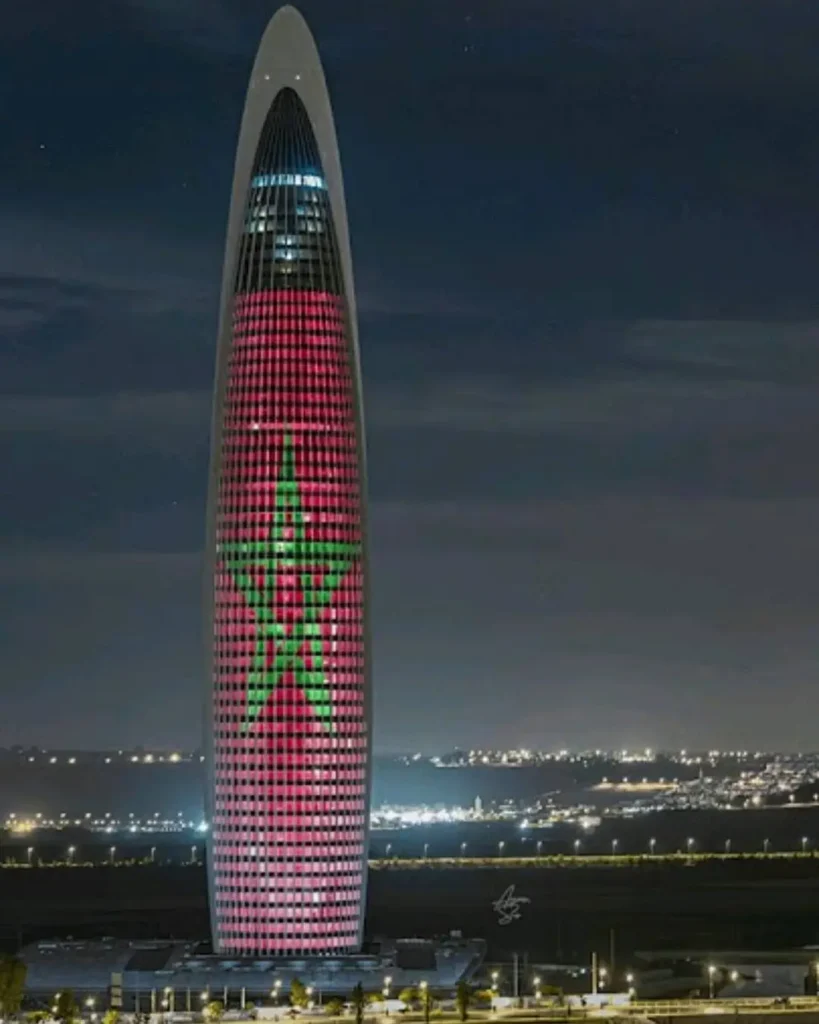
Google “world’s tallest buildings” and you’ll get the usual suspects: Dubai, Shanghai, Kuala Lumpur. What most travelers don’t realize is that Africa has quietly entered the race, and Morocco has staked its claim with the Mohammed VI Tower — a 250-meter, 55-story skyscraper rising from the banks of the Bouregreg River in the city of Salé, just across the water from the capital, Rabat. It’s the tallest structure in Morocco, the third tallest on the African continent, and since late 2025, it has become one of the country’s most ambitious new landmarks.
This guide takes you inside the tower and around it — from the Waldorf Astoria hotel that officially opened its doors in January 2026, to the centuries-old landmarks nearby that make Rabat a city where the 12th century and the 21st exist side by side.
Table of Contents
What Makes the Mohammed VI Tower Different from Other Skyscrapers?
Let’s get this out of the way: the Mohammed VI Tower is not competing with the Burj Khalifa (828 meters) or Merdeka 118 (679 meters) for height records. But what it offers is a fundamentally different experience from standing in a crowd at any other skyscraper in the world.
The tower sits in a relatively quiet city compared to the congested megacities that dominate the world’s tallest buildings lists. It’s surrounded by a landscape that blends the Bouregreg River, the Atlantic Ocean, and historic landmarks dating back eight centuries. The experience here is more intimate: a limited number of hotel rooms, restaurants with notable culinary names attached, and panoramic views over a UNESCO World Heritage city.
The tower’s origin story is worth telling. Othman Benjelloun, the Moroccan billionaire behind the project, drew his inspiration from a visit to NASA in 1969, where he took part in a spaceflight simulation with astronaut Pete Conrad shortly before the Apollo 12 mission. That fascination with space shaped the tower’s design — a rocket poised on its launch pad — brought to life by Spanish architect Rafael de La-Hoz in collaboration with Moroccan architect Hakim Benjelloun.
The Waldorf Astoria: Hilton’s Luxury Debut in Morocco
The most high-profile element of the Mohammed VI Tower for visitors is the Waldorf Astoria Rabat-Salé — the first property of Hilton’s luxury brand in Morocco, which officially opened to the public on January 22, 2026, after hosting VIP guests during the Africa Cup of Nations in December 2025.
The hotel occupies the upper floors with just 55 keys — 44 suites and 11 rooms — at rates starting around 7,000 Moroccan dirhams per night (roughly $700), with suites from 10,000 dirhams. Dining is led by the signature restaurant Al Dabaran, where menus are crafted under the direction of French chef Alain Ducasse, alongside an Asian dinner-only restaurant, a Mediterranean poolside option, and the Peacock Alley lounge. The hotel also features a two-level spa, indoor and outdoor pools, and a fitness center.
Where Does the Tower Rank Among the World’s Tallest Buildings in Africa?
At 250 meters and 55 floors, the Mohammed VI Tower currently holds the third spot on the list of Africa’s tallest buildings, behind Egypt’s Iconic Tower (394 meters) and the minaret of the Great Mosque of Algiers (265 meters).
What sets the Mohammed VI Tower apart within this ranking is its nature as a fully integrated tourism destination: a luxury hotel with global branding, high-end dining, a panoramic observation deck, and commercial and residential spaces — all housed in a single structure overlooking a river, an ocean, and a UNESCO-listed city. That combination makes it a destination in its own right, where a visitor can spend an entire day moving between accommodation, dining, and discovery.
The Observation Deck: Rabat from 250 Meters Up
One of the tower’s strongest draws is its panoramic observation deck at the summit, designed for public access — meaning it’s not limited to hotel guests. As of early 2026, ticketing details and pricing have not been officially announced, so visitors should check with the tower’s management or the Waldorf Astoria concierge for the latest access information before planning their visit.
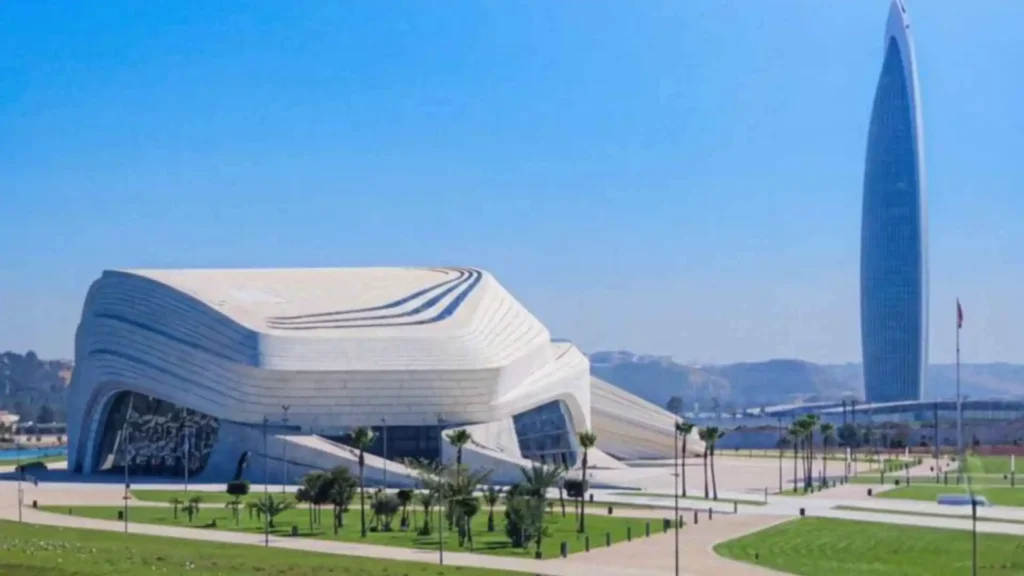
From up there, you can spot the burnt-orange silhouette of Hassan Tower, the green-tiled dome of the Mohammed V Mausoleum, and the Kasbah of the Udayas perched on the edge of the Atlantic. Turn the other way and you’ll see the Grand Theatre of Rabat, Zaha Hadid’s sculptural work that looks like a frozen wave rolling along the riverbank.
The tower was designed to be visible from 50 kilometers away, but the reverse is equally true: from its summit, you can scan the full skyline of the twin cities of Rabat and Salé, with the Atlantic stretching out behind them. Sunset is the ideal time to visit — when the sky turns orange over the ocean and the city lights start flickering on below.
Beyond the Tower: Rabat’s Landmarks That Match the Ambition
The Mohammed VI Tower doesn’t exist in isolation. It’s part of the larger Bouregreg Valley development project, which transformed the riverbanks into a modern urban waterfront that complements the city’s historic fabric. This is what makes Rabat ideal for travelers who want variety packed into a single day.
Hassan Tower and the Mohammed V Mausoleum
A few minutes’ drive from the tower, Hassan Tower stands as a monument to Sultan Yacoub al-Mansour’s ambition to build the world’s largest mosque in 1195. Construction halted after the sultan’s death in 1199, leaving the 44-meter minaret surrounded by the skeletal columns of the unfinished mosque. Right next to it sits the Mohammed V Mausoleum, a showcase of modern Moroccan craftsmanship with intricate zellij tilework and carved plaster.
Kasbah of the Udayas
This clifftop fortress overlooking the river mouth and the Atlantic is one of the most photographed spots in Morocco. Its blue-and-white painted alleys, Andalusian gardens, and ocean-facing cafés make it an essential stop on any Rabat itinerary.
The Grand Theatre of Rabat
Designed by the late Iraqi-British architect Zaha Hadid, this is one of the largest theaters in Africa and the Arab world, spanning roughly 27,000 square meters. The main hall seats 1,800, with a secondary 520-seat theater and an open-air amphitheater for 7,000. Its fluid form appears to flow with the river current, and it’s one of the best photography spots in the city.
Mohammed VI Museum of Modern and Contemporary Art
Morocco’s first national museum of contemporary art, located a short distance from the tower. It houses a permanent collection of Moroccan artists from the 1950s to the present, alongside rotating international exhibitions.
Chellah Archaeological Site
A Roman-then-Islamic archaeological site enclosed by massive Marinid-era walls and surrounded by lush gardens overlooking the Bouregreg River. The site layers Roman ruins dating to the 3rd century BC with royal tombs from the Marinid dynasty.
Sustainability: A Detail That Matters to the Conscious Traveler
At a time when more travelers are factoring their environmental footprint into trip planning, the Mohammed VI Tower positions itself as a green building pursuing both LEED Gold and HQE international certifications. The tower’s south-facing façade is covered with over 3,300 square meters of solar panels. The building also incorporates rainwater harvesting, greywater recycling systems, and smart façades that reduce solar heat gain and cut down on air conditioning demand.
For travelers who want luxury without the environmental trade-off, the tower aims to offer that balance without compromising on comfort or service.
Practical Tips Before You Go
If you’re planning a visit, the best periods are spring (March through May) and fall (September through November), when the weather is mild and the skies are clear — ideal conditions for catching sunset from the observation deck.
Getting there is straightforward: Rabat-Salé International Airport is only 15 kilometers from the tower, and Morocco’s high-speed train, the Al Boraq, connects Tangier and Casablanca to Rabat-Agdal station. What makes planning your day easy is that the tower, Hassan Tower, the Kasbah of the Udayas, and the Grand Theatre all sit along a single axis stretching across both banks of the Bouregreg River, making it entirely possible to visit them all in one day without long commutes.
Why Rabat Deserves a Spot on Your List
Morocco is aiming to welcome 26 million tourists by 2030, and the Mohammed VI Tower is one of its strongest cards. But what makes Rabat different from the usual skyscraper destinations is a combination you rarely find elsewhere: a 250-meter modern tower standing meters away from 12th-century monuments, a hotel from one of the world’s most prestigious brands overlooking a river, an ocean, and a UNESCO World Heritage city — all in a capital that hasn’t lost its character despite the modernization.
The Mohammed VI Tower isn’t trying to be the tallest in the world. But it stands apart from most skyscraper experiences by offering something that height alone can’t deliver: a setting where modern ambition and deep-rooted heritage meet within walking distance of each other.
Read also: