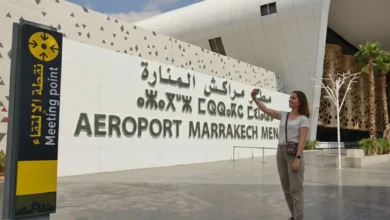
Royal Air Maroc Business Class 2026: Is It Worth Your Money or Will You Regret It?

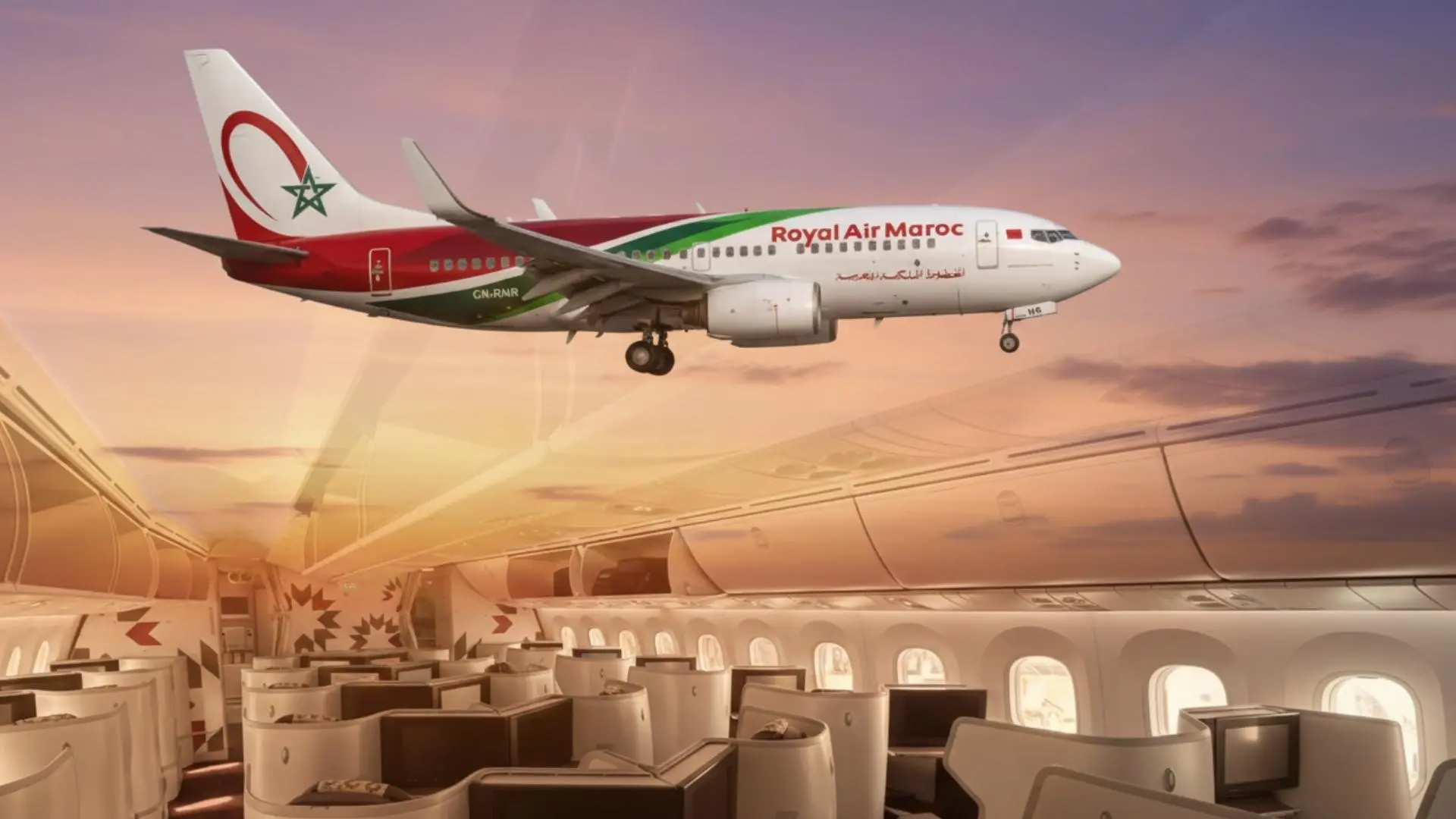
When a foreign traveler decides to head to Morocco — whether from New York, London, or Paris — Royal Air Maroc is almost always the first option that comes to mind. The Moroccan national carrier connects the Kingdom to over a hundred destinations worldwide, and its 2020 membership in the oneworld alliance raised the bar for what passengers can reasonably expect.
But the question every informed traveler asks before hitting the book button is: does Royal Air Maroc business class genuinely justify the price difference, or is your money better spent elsewhere?
This guide won’t give you selective praise or exaggerated criticism — just a complete, honest picture to help you make a decision based on real information.
Table of Contents
Part One: The Airport Experience — It Starts Before You Board
Business class begins on the ground, and the airport experience sets the tone for everything that follows.
Mohammed V International Airport — Casablanca
The airport is bright, clean, and spacious. Its reputation was mixed in years past, but recent expansions have genuinely shifted the first impression. Business class passengers are directed to dedicated check-in counters away from the economy queues — fast and hassle-free. A Fast Track security lane is available for business class ticket holders and loyalty program members, saving meaningful time during peak hours.
The lounge is spread across two levels: the lower floor houses a buffet with a range of Moroccan and international dishes, while the upper floor is dedicated to seating and relaxation. One detail that consistently stays in travelers’ memories is the outdoor terrace overlooking the tarmac — a feature you rarely find in European lounges, giving you a chance to breathe fresh air and watch aircraft movements before departure.
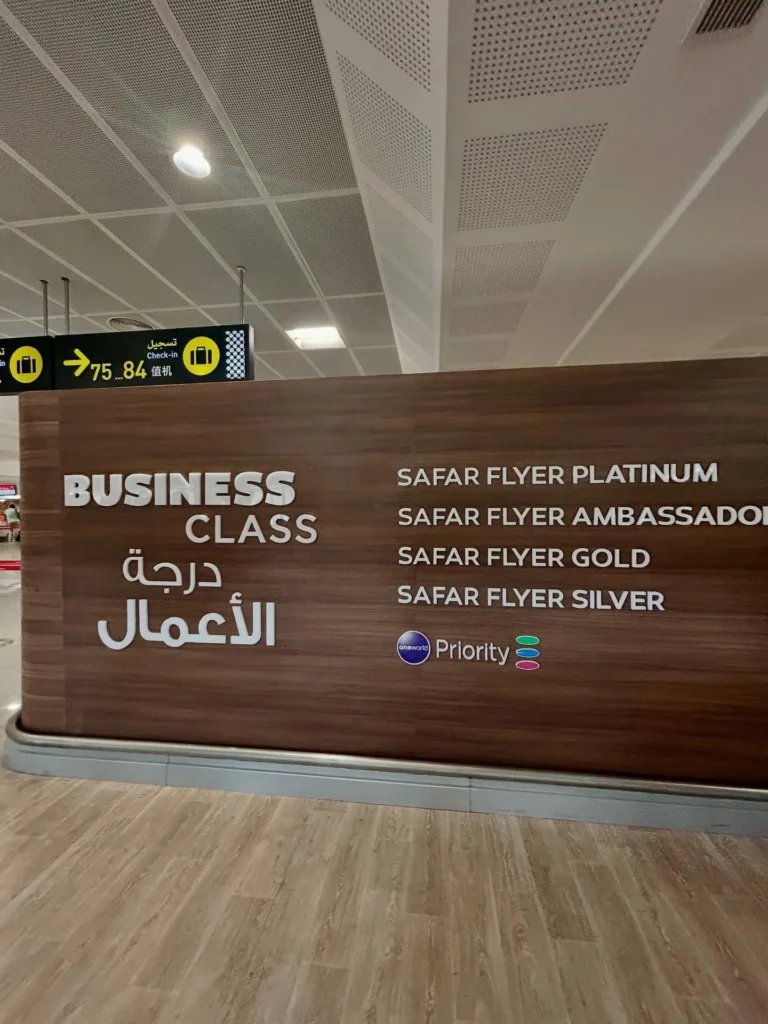
Practical tip: If your schedule allows, aim to be in the lounge around lunchtime — the selection is broader and fresher compared to early morning hours.
One honest caveat: The domestic terminal lounge is a noticeably different experience from the international wing. If your journey involves a domestic connection within Morocco, expect more limited seating and food options. Worth knowing in advance.
International Departure Points
At JFK New York, Royal Air Maroc operates from Terminal 1. Business class passengers are directed to a partner lounge offering a calm environment, full bar service, and a comfortable buffer from the airport’s usual chaos. In Paris (CDG and Orly), Fast Track access cuts through the notoriously long security queues, and oneworld partner lounges are accessible for eligible passengers.
Part Two: The Seats — Where Aircraft Type Makes All the Difference
The most important thing to understand upfront: the experience is not uniform across the fleet. The aircraft you fly on — not just the airline — will largely determine what kind of business class you get.
Boeing 787-9 Dreamliner — The Flagship Experience
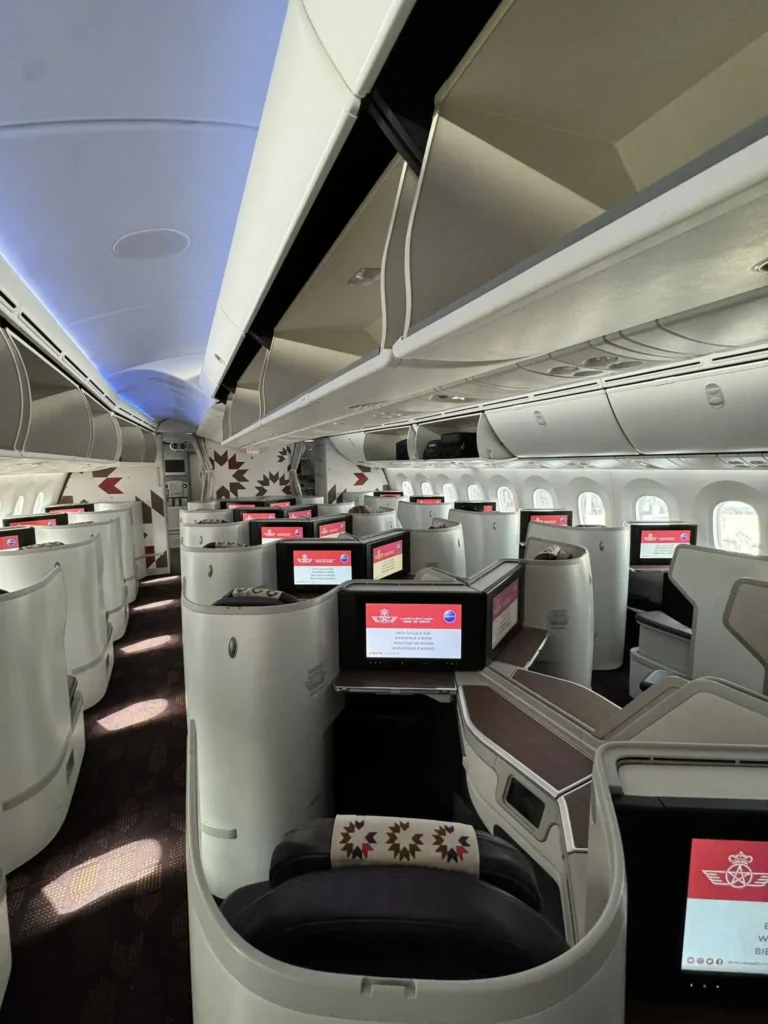
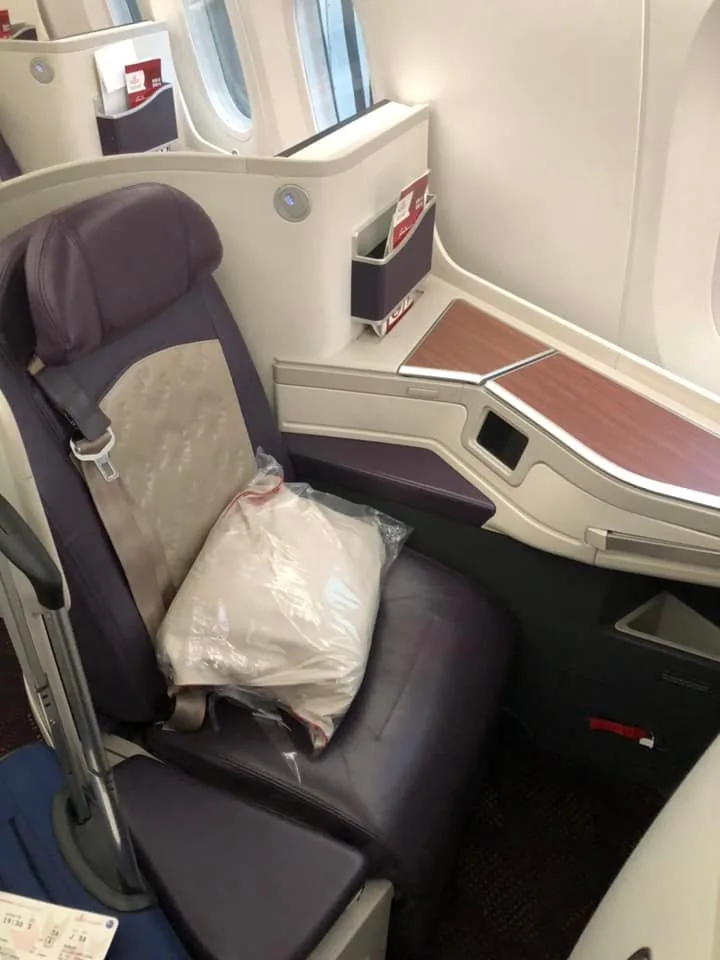
When you book Royal Air Maroc business class Boeing 787-9, you’re stepping into a genuinely different category. The 1-2-1 seat configuration means every single passenger has direct aisle access without climbing over anyone — a detail that matters enormously on long-haul flights.
The seat converts into a fully flat bed long enough for passengers of average height to sleep without bending their knees. Side panels create a cocoon-like sense of privacy — many travelers describe it as a personal shell rather than just a seat. The newest additions to the fleet, originally configured for a Canadian carrier, feature a sleek Collins Aerospace Super Diamond layout in dark, contemporary tones with just 16 seats in a 1-2-1 arrangement, offering exceptional exclusivity.
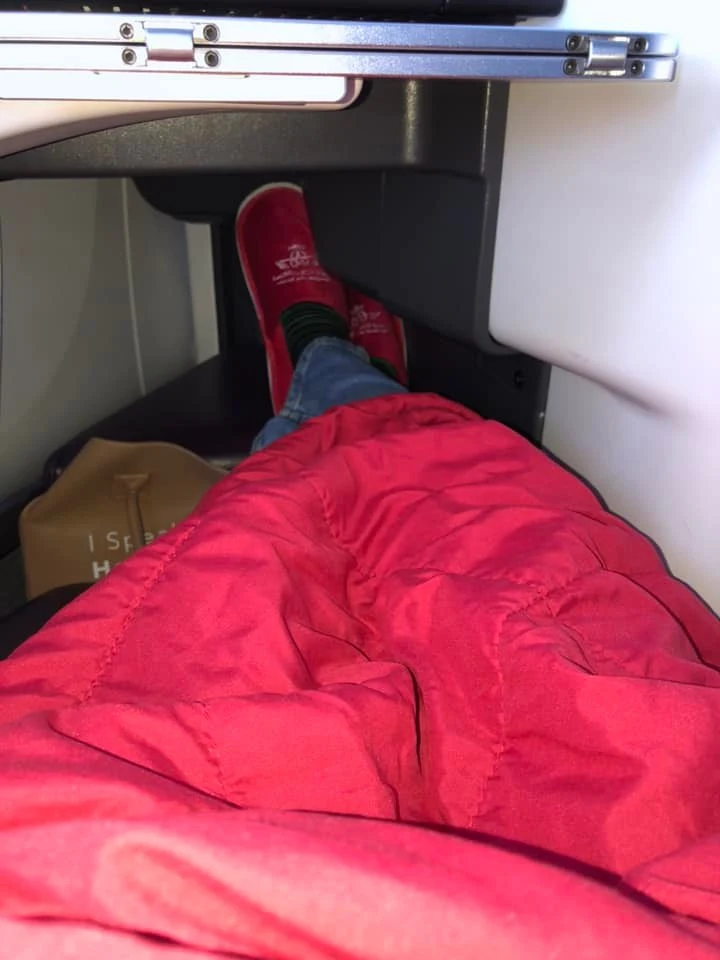
Technical highlights unique to the Dreamliner: The electrochromic windows — no traditional blinds, just a button that gradually dims the glass — are significantly larger than on conventional aircraft. Cabin humidity levels are notably higher than on most commercial jets, which noticeably reduces eye and skin dryness on long flights. The interior lighting is programmed to help minimize jet lag on transatlantic routes. Engine noise is impressively low, particularly during takeoff and cruise.
Universal power outlets are available beside each seat — but remember to ask the crew to activate them, as they don’t always work automatically.
Boeing 787-8
The seat configuration here is 2-2-2, and the beds are fully flat as well. The trade-off: window-seat passengers need to step past their neighbor to reach the aisle — a minor inconvenience that adds up on longer flights. Still a comfortable and genuinely restful option.
Boeing 737-800 and 737 MAX 8
On Royal Air Maroc business class 737 routes — typically medium-haul to Europe or within Africa — the seat is a Recliner, not a flat bed. This is standard practice across the industry for routes of this length.
Where Royal Air Maroc earns credit here is the 2-2 seat layout, putting two seats on each side of the aisle. Compare this to several European carriers that simply leave the middle seat empty in a 3-3 configuration and call it business class. The seat pitch reaches up to 36 inches — perfectly adequate for a two-to-four-hour flight.
This isn’t luxury in the intercontinental sense, but it’s solid medium-haul business class that competes respectably with European counterparts on similar routes.
| Aircraft | Configuration | Seat Type | Key Note |
|---|---|---|---|
| Boeing 787-9 | 1-2-1 | Fully flat bed | Direct aisle access, maximum privacy |
| Boeing 787-8 | 2-2-2 | Fully flat bed | Window seat passengers step over neighbor |
| Boeing 737-800 | 2-2 | Recliner | Better than most European short-haul business |
| Boeing 737 MAX 8 | 2-2 | Modern Recliner | Sky Interior lighting, quieter engines |
Part Three: The Food — Moroccan Identity at 35,000 Feet
The Royal Air Maroc business class menu is one of the carrier’s most talked-about strengths, and it tends to stay in passengers’ memories long after the flight.
Long-Haul Flights
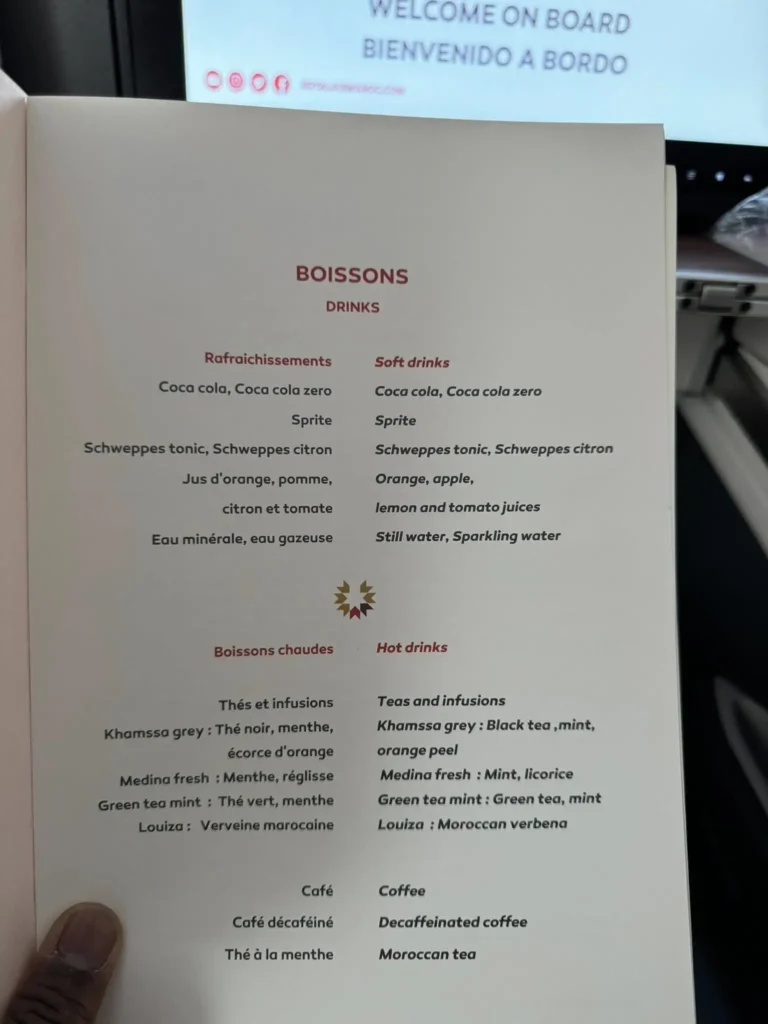
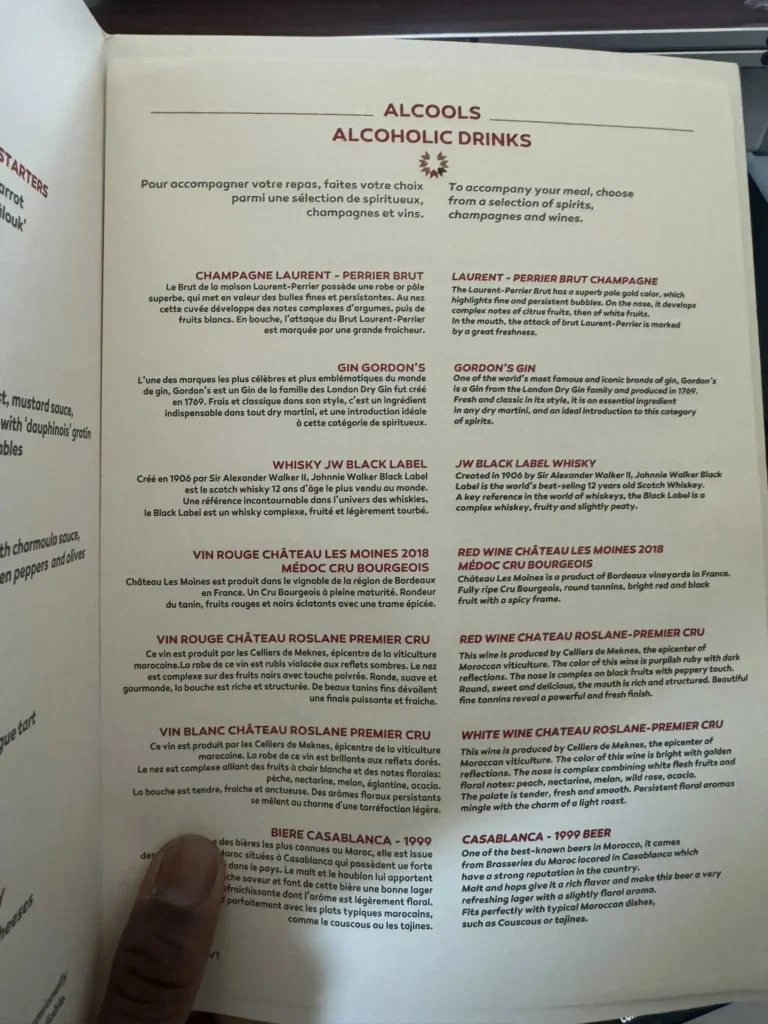
A warm towel greets you upon boarding, followed by a welcome drink — champagne in most cases, or fresh juice. The meal service unfolds in multiple courses, often presented as À la Carte on certain routes:
Starters range from fresh salads and hearty harira soup to more refined options like foie gras mousse on select flights. The main course leans unmistakably Moroccan — slow-cooked lamb that reportedly melts in the mouth, or chicken prepared with authentic Moroccan spicing. A cheese trolley follows, then fresh fruit or a dessert to close.
What sets this apart from European carriers is the cultural identity on the plate. This isn’t a generic airline meal — it’s a deliberate introduction to Moroccan hospitality before you’ve even landed.
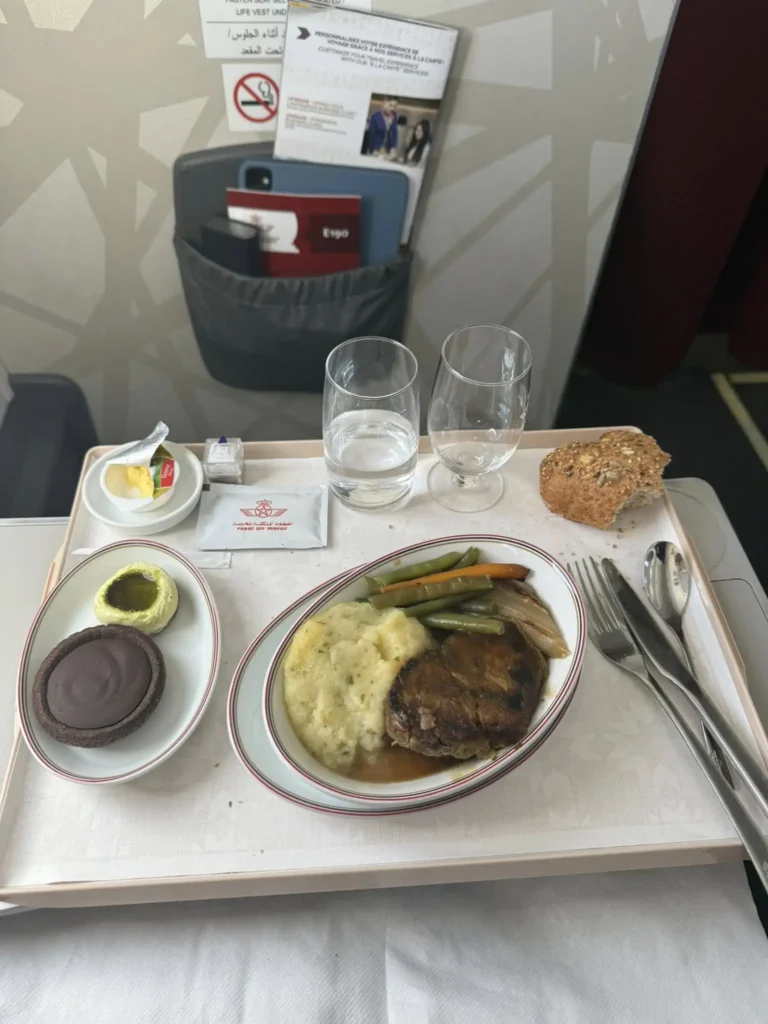
Medium-Haul Flights
A main course with a choice of chicken, fish, or pasta, paired with unlimited beverages. Straightforward for a short flight, and still a step above what many carriers offer on comparable routes under the business class label.
Part Four: The Crew — Genuine Warmth as a Competitive Edge
Cabin crew are consistently described across traveler reviews as warm, present, and genuinely welcoming. The service carries a national pride that translates into attentiveness you don’t always find in larger, more transactional airlines.
That said, honesty requires noting that call button response times occasionally stretch beyond five minutes on some flights — a gap that travelers accustomed to Gulf or Asian carriers will notice. It doesn’t undermine the overall experience, but it’s a real area for improvement.
Part Five: Entertainment and Connectivity — The Weakest Link
This is where the honest conversation has to happen. The screens are large and eye-friendly (15.3 inches on Dreamliner flights), and the library covers recent Hollywood releases, Arabic-language content, and Moroccan documentaries. The noise-canceling headphones are functional — adequate, but not at the level of equivalents offered by top-tier competitors.
Wi-Fi is available on select Royal Air Maroc aircraft, most notably the newest Boeing 787-9 jets, which allow passengers to stay connected during long-haul flights. That said, the service is not available across the entire fleet or on every route. Before booking, it’s worth checking whether your specific flight offers connectivity — particularly if staying online is a priority for your journey.
Part Six: Baggage and Upgrade Costs
Baggage Allowance — A Real Competitive Advantage
Royal Air Maroc business class baggage allowance ranks among the most generous policies in this category:
On flights to the US, Canada, and Africa: three checked bags at 23 kg each (69 kg total), plus two carry-on bags. On European routes: two checked bags at 32 kg each. For travelers carrying professional equipment or returning with significant purchases, this allowance alone can offset a meaningful portion of the fare difference.
Upgrading to Business Class
Royal Air Maroc business class upgrade cost is accessible through several channels:
The Plusgrade system allows you to submit a bid 15–24 hours before departure. If accepted, the amount is charged to your card. Safar Flyer miles upgrades start from 3,750 miles on domestic routes and reach approximately 20,000 miles for transatlantic flights. Last-minute airport upgrades occasionally appear within 12 hours of departure at significantly reduced rates, typically including lounge access and additional baggage.
If you’re looking for the experience at the lowest possible cost, monitor upgrade offers two to four days before your flight — that’s typically the window when the most competitive pricing appears.
| Route Zone | Miles Required (One Way) | Notes |
|---|---|---|
| Domestic Morocco | 3,750 miles | Excellent value for short trips |
| Europe (Zone 1) | 7,000 miles | Ideal for Paris–Casablanca upgrade |
| USA / Middle East | 20,000 miles | Best miles value on long-haul |
| Asia | 26,500 miles | Longest network routes |
Part Seven: Paris–Marrakech — Does Business Class Justify the Gap?
The Royal Air Maroc business class Paris Marrakech route is among the most searched itineraries for European travelers. A round-trip business class ticket typically ranges between $1,600 and $2,200 — against low-cost options starting around $70.
What makes the premium worth considering:
Marrakech airport gets congested, particularly in peak season. Business class priority on baggage and passport control can realistically save you over an hour compared to economy arrivals. Stepping off the plane in good physical shape — without the back pain and fatigue of a cramped budget seat — gives you the energy to explore immediately rather than recovering in your hotel room. And on a Boeing 737-800 Royal Air Maroc business class or MAX flight, you’re getting a real meal and a proper seat, not a plastic snack bag.
Is the full gap justified? That depends entirely on your priorities. For a honeymoon, a special occasion, or a high-stakes business trip, the answer leans clearly toward yes.
The Drawbacks — Because the Full Picture Matters More Than Marketing
Inconsistency across routes: The medium-haul business class experience is categorically different from the Dreamliner. Check the aircraft type before booking to avoid mismatched expectations — SeatGuru is your friend here.
Wi-Fi: Available on select aircraft, particularly the newest 787-9 jets, but not guaranteed across all flights. Verify availability for your specific route before booking.
Headphones: Functional, but below the benchmark set by Gulf and Asian carriers.
Power outlets on older 737s: Some older 737-800 aircraft lack USB ports. Charge your devices before boarding.
Document checks in transit: Casablanca transit passengers may be asked to present their passport multiple times — a security procedure that some travelers find repetitive.
Practical Tips Before You Fly
Choose your seat carefully: On the 787-9, solo travelers benefit most from single window seats in the 1-2-1 layout. Some middle-row seats have windows that don’t align with the seat position — check SeatGuru before selecting.
Register for Safar Flyer: Miles accumulate quickly in business class and unlock upgrade opportunities and airport privileges.
Special meals: Vegetarian, halal, or dietary-specific meals can be requested up to 24 hours before departure through the airline’s website.
Overnight flights from New York: Tell the crew you prefer not to be woken for breakfast if sleep is your priority. The Dreamliner seats are comfortable enough to sleep deeply all the way through.
Frequently Asked Questions
Is Royal Air Maroc business class good?
Yes — particularly on long-haul Dreamliner routes. The fully flat bed, multi-course Moroccan-inspired meal, and warm crew service make for a genuinely strong experience. On medium-haul flights with the 737, it’s solid but more modest. Managing your expectations by aircraft type is key.
What is the Royal Air Maroc business class baggage allowance?
On flights to the US, Canada, and Africa, business class passengers are entitled to three checked bags at 23 kg each (69 kg total), plus two carry-on bags. On European routes, the allowance is typically two checked bags at 32 kg each. Always verify the specific policy for your route on the airline’s website before travel.
Does Royal Air Maroc business class have flat beds?
Yes — but only on Boeing 787 Dreamliner aircraft (both the 787-8 and 787-9). On Boeing 737-800 and 737 MAX 8 flights, seats are recliner-style and do not convert into flat beds. If a flat bed is a priority, confirm the aircraft type for your specific flight before booking.
How much does it cost to upgrade to Royal Air Maroc business class?
Upgrade costs vary significantly by route and availability. Through the Plusgrade bidding system, you can submit an offer 15–24 hours before departure. Safar Flyer miles upgrades start from 3,750 miles on domestic routes and around 20,000 miles for transatlantic flights. Last-minute airport upgrades are occasionally available at reduced rates within 12 hours of departure.
Does Royal Air Maroc business class have Wi-Fi?
Wi-Fi is available on select aircraft, most notably the newest Boeing 787-9 jets. However, it is not available on all aircraft or routes. It’s advisable to check connectivity availability for your specific flight when booking.
What is the Royal Air Maroc business class seat configuration on the 787-9?
The Boeing 787-9 features a 1-2-1 configuration, meaning every passenger has direct aisle access without stepping over a neighbor. The newest 787-9 additions to the fleet (formerly configured for a Canadian carrier) have just 16 seats in the same 1-2-1 layout, offering an especially private experience.
Is Royal Air Maroc business class worth it on the Paris–Marrakech route?
For a 3.5-hour flight, it depends on your priorities. The 2-2 seat layout, real meal service, and airport priority perks (including lounge access and faster passport control) are genuine advantages over low-cost alternatives. For leisure travelers on a budget, economy is manageable. For special occasions or business trips where comfort and time efficiency matter, the upgrade is often worth considering.
What is the Royal Air Maroc business class menu like?
On long-haul flights, the menu is multi-course and leans heavily on Moroccan culinary identity — expect harira soup, slow-cooked lamb or chicken with traditional spicing, a cheese selection, and fresh fruit or dessert. A welcome drink (usually champagne or juice) and warm towel are offered upon boarding. On medium-haul flights, a single main course is served with unlimited beverages.
The Verdict: Is Royal Air Maroc Business Class Worth It in 2026?
The honest answer to “is Royal Air Maroc business class good” is: yes — with important caveats.
On Dreamliner aircraft and long-haul routes, the premium is clearly earned: a genuine flat bed, culturally distinctive food, a quiet and comfortable cabin, and warm human service. If you’re flying to or from Morocco on a route of four hours or more, investing in business class is a decision most travelers don’t regret.
On shorter and medium-haul routes, evaluate the specifics: what exactly do you get for the price difference on your particular flight? If physical comfort and premium service are priorities, the answer still tilts toward upgrading. If price is your only consideration, economy is manageable for short distances.
Royal Air Maroc is a carrier in genuine upward trajectory. Its business class competes seriously with European counterparts and surpasses them in several respects — particularly when you factor in the Moroccan hospitality that begins at 35,000 feet and sets the tone for everything that follows on the ground.
Have you flown Royal Air Maroc business class? Share your experience in the comments below.
NB: All in-flight photos featured in this article were sourced from the Facebook group Business Class & First Class Flight Deals & More Group, a community of travelers sharing first-hand premium cabin experiences from around the world.
Read Also: