At a Glance — Sahara Desert Morocco: The Essentials
- Where: Southeastern Morocco. Two main dune systems — Erg Chebbi (Merzouga) and Erg Chigaga (M’Hamid El Ghizlane). The Agafay rocky desert sits just 30 km from Marrakech.
- How to get there: 560 km from Marrakech (8–10 hrs) or 460 km from Fes (7–9 hrs), crossing the High Atlas via the Tizi n’Tichka pass.
- Best time to visit: Spring (March–May) and fall (September–November). October is the single best month. Avoid June–August (45°C+).
- How long you need: Minimum 3 days for a round trip from Marrakech. 4–5 days recommended for a relaxed pace with two nights in the desert.
- Budget: Group tours from €70–150/person (3 days). Desert camps from €30/night (standard) to €200/night (luxury with private bathroom). Camel trek: €10–30/person.
- Don’t miss: Sunrise over Erg Chebbi, overnight camel trek to a desert camp, stargazing with zero light pollution, mint tea with nomadic families, Aït Benhaddou UNESCO site en route.
- Now, the full story — from someone who’s walked these sands and wants to make sure you do it right.
Table of Contents
Somewhere south of the Atlas Mountains, where the last almond trees give way to an endless canvas of orange and gold, there exists a world that looks nothing like anything you’ve ever known. Here, in the Sahara Desert in Morocco, time isn’t measured in hours but in the shifting gradients of light across the dunes. Sunset isn’t something you watch — it’s something that happens to you.
Over years of crossing this extraordinary landscape, and through countless conversations with Amazigh guides and travelers who walked these sands before me, I’ve learned one fundamental truth: the Moroccan Sahara isn’t a place you visit. It’s a place you inhabit, even if only for a few days. And this article is the distillation of all those experiences — a field-tested, no-fluff roadmap to help you turn a Sahara desert trip into something that genuinely shifts the way you see the world.
Whether you’re planning a Morocco Sahara desert tour from Marrakech for the first time, hunting for the right Merzouga luxury desert camp, weighing your options between a camel ride in Morocco and a 4×4 desert safari, or simply wondering whether the whole thing is worth the eight-hour drive — keep reading. I wrote this for you.
Why Morocco Is the Best Gateway to the Sahara
You might assume the Sahara is the Sahara wherever you go. It’s not. The Moroccan slice of this 3.6-million-square-mile desert is uniquely suited to travelers because it offers something rare: infrastructure without sterilization. Paved roads reach the very edge of the sand at Merzouga. Camps range from bare-bones Berber tents to suites with en-suite bathrooms and hot showers. And yet, the culture hasn’t been vacuum-sealed for tourist consumption.
The generosity here is ancestral, not transactional. When an Amazigh man invites you into his tent for mint tea, the glass in your hand carries centuries of hospitality. Antoine de Saint-Exupéry, who flew mail routes over these very sands between Tarfaya and Dakhla in the 1930s, wrote in Wind, Sand and Stars that the desert is where a person sheds everything to discover what truly deserves to remain. That’s precisely the feeling this place delivers.
A legend worth knowing before you go
Before we get into logistics, let me share something that will color everything you see once you’re standing on the dunes. In The Last Storytellers, journalist Richard Hamilton records a tale told by Moroccan storyteller Ahmed Temiicha about the birth of the Sahara itself:
Long ago, the earth was one vast garden — lush palms, jasmine, nightingales. Then someone told a lie. A very small lie, of no importance. God said: “Each time one of you lies, I shall throw a grain of sand onto the earth.” The people shrugged. A grain of sand? What difference will that make? And so, lie after lie, the Sahara came into existence. But the oases scattered here and there? Those are traces of the original garden — because not all people lie.
I think about this story every time I spot a palm grove rising from the dunes. It adds a layer of meaning that no travel brochure can manufacture.
A Map of Morocco’s Deserts: Not All Sand Is Created Equal
One of the most common mistakes first-timers make is assuming “the desert in Morocco” means a single destination. In reality, the country harbors a striking variety of desert landscapes, each with its own character. Let me walk you through the main ones.
Erg Chebbi Dunes, Merzouga — The Icon
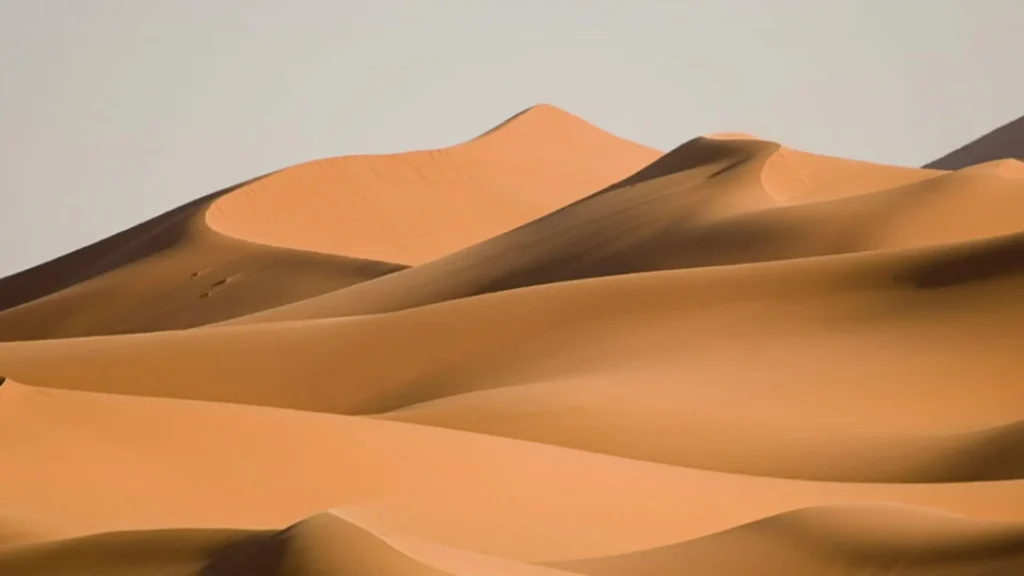
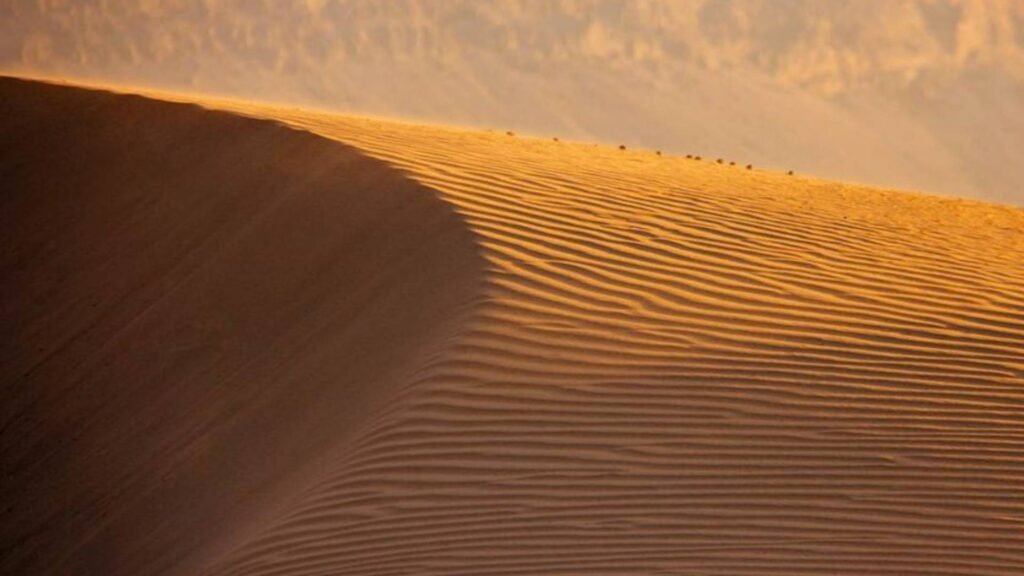
If one image defines the Sahara Desert Morocco experience in the global imagination, it’s the towering orange dunes of Erg Chebbi. Located on the outskirts of the small village of Merzouga in southeastern Morocco, this massive dune field includes peaks reaching 160 meters — the tallest in the country.
What sets Erg Chebbi apart isn’t just height. It’s the warm orange hue that shifts through shades of gold, rose, and crimson as the sun moves across the sky. This is why photographers and content creators flock here chasing the perfect golden-hour shot.
Practically speaking, Merzouga is the most accessible Sahara gateway. The paved road ends right at the edge of the sand. There’s a full tourism ecosystem — desert camps at every budget level, cafés, and stable internet. If this is your first desert experience or your schedule is tight, Merzouga is your natural starting point. The range of Merzouga desert camps available today means there’s genuinely something for every traveler, from minimalist Berber tents to full-service glamping setups.
Erg Chigaga — Where Real Silence Begins
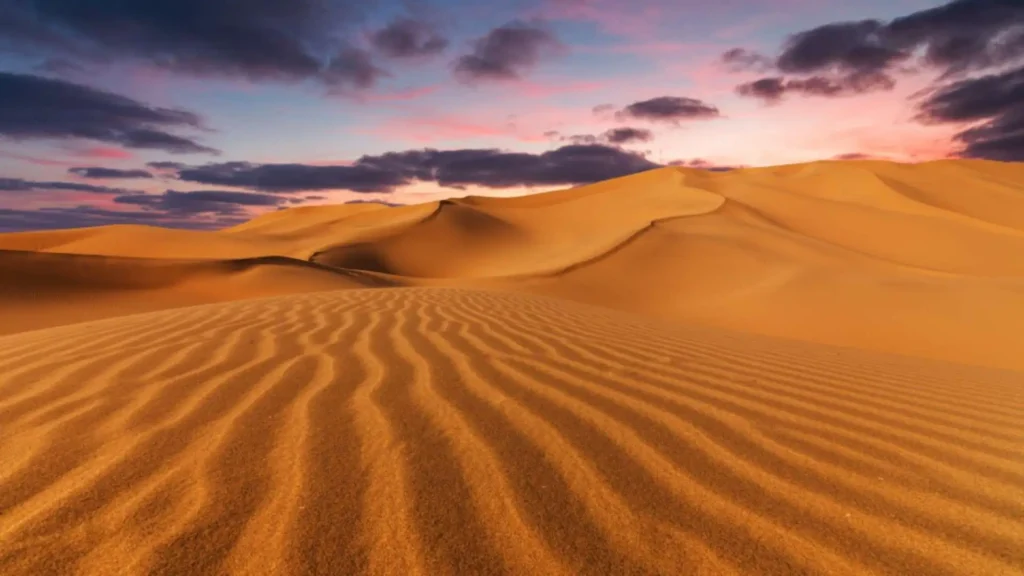
If Merzouga is the Sahara’s front door, Erg Chigaga is the back country. Located south of M’Hamid El Ghizlane, this dune system stretches over 40 kilometers — making it Morocco’s largest sand sea by horizontal area, though its dunes are slightly shorter than Erg Chebbi’s at around 120 meters.
Getting here is an expedition in itself. You’ll need a 4×4 to cover roughly 60 kilometers of off-road terrain through dry riverbeds and salt flats like Lake Iriki. This isolation is exactly the point: no engine noise, no village lights, nothing between you and a sky so thick with stars it looks fake.
My advice: if you’re an experienced traveler seeking raw, unfiltered desert far from the beaten path, Erg Chigaga will make you feel like the last person on earth — in the best possible way.
Agafay Desert — The Desert With No Sand
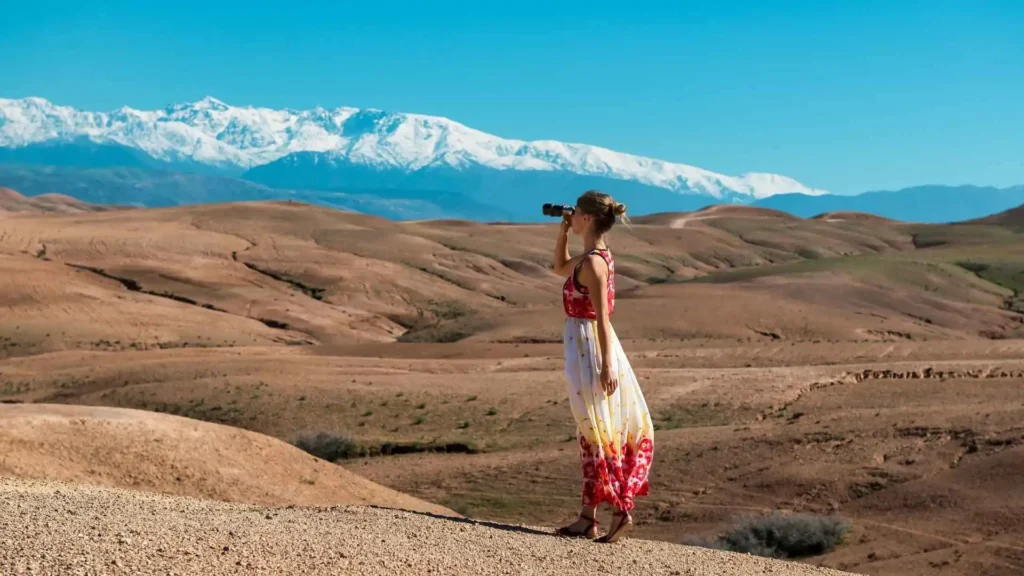
Just 30 kilometers from the chaos of Marrakech, the Agafay Desert surprises visitors with its moon-like rocky terrain. No golden dunes here — instead, a dry plateau of pale stones stretching across hundreds of hectares, with the snow-capped Atlas Mountains as a backdrop.
Agafay isn’t a substitute for the Sahara. It’s a different experience entirely. You can reach it by regular car in under an hour from Marrakech, making it perfect for travelers who can’t commit to the long drive south. A quad biking session across its rugged terrain followed by a night under the stars with the Atlas in the distance — that’s the Agafay promise.
One source captures it well: the rocks piled in majestic silence, sculpted like the facade of a Gothic cathedral, often resemble the surface of the moon.
Zagora and Tinfou Dunes — The Southern Gateway
The Tinfou dunes sit a short distance from the town of Zagora in the Draa Valley. They’re smaller and more accessible than Erg Chebbi, making them ideal for a first taste of desert life without a multi-day commitment. A Zagora desert tour gives you a camel trek, a night in a basic camp, and an introduction to oasis life in the Draa Valley.
Quick Comparison
| Destination | Location | Character | Access | Crowd Level |
|---|---|---|---|---|
| Erg Chebbi | Merzouga | Towering dunes (160m), orange sand | Paved road to the edge | High |
| Erg Chigaga | M’Hamid El Ghizlane | Vast expanse (40km), total isolation | 4×4 only | Low |
| Agafay Desert | 30km from Marrakech | Rocky, lunar terrain | Regular car | High |
| Tinfou Dunes | Zagora | Small, accessible dunes | Paved road | Medium |
Getting There: The Journey That’s a Destination in Itself
Crossing the High Atlas
Here’s something you need to know early: the distance between Marrakech and Merzouga exceeds 560 kilometers and takes 8 to 10 hours by road. This is not a trip you rush. But I’ll also tell you this: the road itself is worth every minute.
The route from Marrakech passes through the Tizi n’Tichka pass in the High Atlas, climbing to 2,260 meters. The switchbacks are sharp and the elevation gains dramatic, but the views reward you at every turn: Amazigh villages clinging to mountainsides, almond trees blossoming in spring, green valleys slicing through bare rock.
A practical note: if you’re prone to motion sickness, bring medication. If you’re driving yourself, avoid night driving completely — lighting is minimal on many stretches, and animals wandering onto the road is a real possibility.
Stops You Shouldn’t Skip
The road to the desert isn’t just transit. Here are the stops that turn the drive into an adventure of its own:
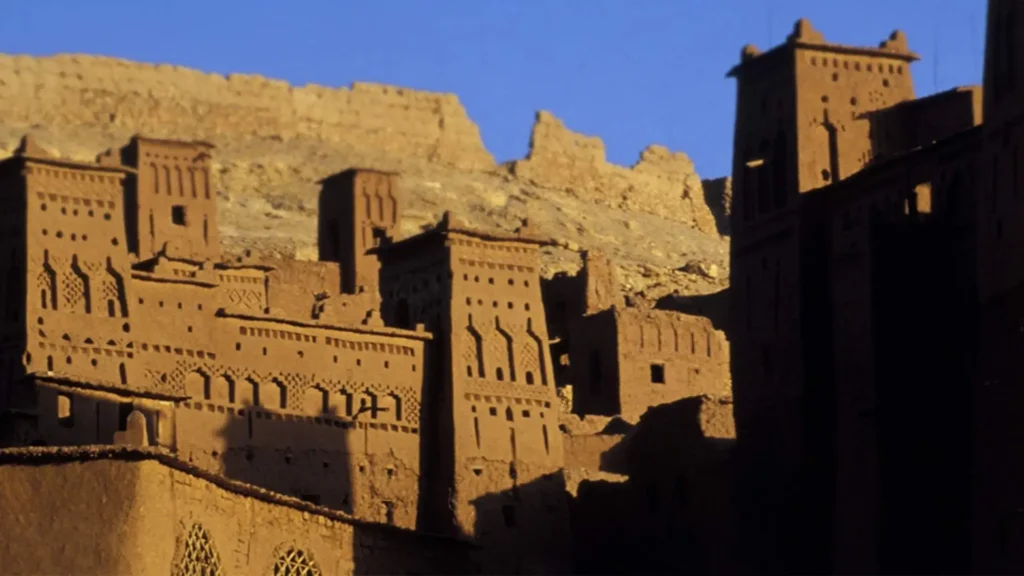
Ait Benhaddou (Aït Benhaddou): A UNESCO World Heritage Site and a masterpiece of Moroccan earthen architecture. This fortified village served as a backdrop for films including Lawrence of Arabia, Gladiator, and Game of Thrones. A handful of families still live inside its walls, lending it a vitality that goes beyond pure heritage.
Ouarzazate — The Gateway to the Desert: Also nicknamed “Ouarzawood,” this city has attracted global film production since the 1980s. You can tour the Atlas Film Studios (allow 90 minutes), walk through strikingly realistic sets, and visit the 17th-century Taourirt Kasbah.
Todra and Dades Gorges: Vertical rock walls rising hundreds of meters, cradling green palm oases below — a stunning contrast to the dry desert ahead. If you’re a photographer, this stop alone will be among the highlights of your trip.
The Draa Valley: If you take the southern route through Zagora toward M’Hamid El Ghizlane, you’ll pass through Morocco’s longest river valley, home to over 3 million date palms and crumbling kasbahs in various states of magnificent decay.
When to Go: Best Time to Visit Sahara Desert in Morocco
Spring and Fall — The Sweet Spot
If you ask me the best time to visit the Sahara Desert in Morocco, my answer is immediate: spring (March–May) and fall (September–November). Daytime temperatures hover between 20°C and 30°C (68–86°F), and nights are pleasantly cool — perfect for sleeping in camp and stargazing without shivering.
October is arguably the single best month: temperatures are comfortable across all regions, crowds are thinner than the spring peak, and the golden afternoon light gives photographs an extraordinary quality. It also coincides with the date harvest festival in Erfoud.
March brings landscapes back to life after winter, with wildflowers blooming in the mountains. But be prepared: sandstorms can sweep through the Sahara during this month.
Winter — Quiet Beauty, Cold Nights
Between December and February, daytime temperatures are mild (15–25°C / 59–77°F), but desert nights can plunge close to freezing. If you’re planning a winter visit, pack warm layers and extra blankets even if your camp provides them. The upside: minimal crowds and better prices.
Summer — Avoid If You Can
From June to August, temperatures exceed 45°C (113°F) during the day, and tents become unbearable. Most camps close entirely. The one exception: if you’re interested in psammatotherapy — the ancient sand-bath therapy practiced in Merzouga during summer months, where the body is buried in naturally heated sand (around 45°C) to treat rheumatism and joint pain. It’s a centuries-old tradition that draws Moroccans and Algerians from across the region, now gaining recognition in wellness tourism circles.
Choosing Your Tour: Which Format Fits You Best?
The Classic 3-Day Desert Tour from Marrakech
Most Morocco Sahara desert tours from Marrakech follow a 3-day / 2-night format. The standard route passes through Aït Benhaddou and the Dades Valley on day one, then Todra Gorge and Merzouga on day two (with a night in a desert camp), returning on day three.
Prices typically range from €70 to €150 per person for group tours. This covers transport, accommodation, meals, and a camel trek.
My honest take: three days give you a solid overview, but you’ll spend a significant chunk of the time in the car. If you can stretch to four days, you’ll gain a much more relaxed pace and the chance to actually stop and absorb.
Going Deeper: 4–5 Days or More
For travelers who want to go beyond the surface, I recommend at least 4 to 5 days with two nights in the desert. The first night is for settling in. The second is where the real magic happens: walking barefoot on cool sand at dawn, visiting nomadic families, watching the Milky Way without a schedule breathing down your neck.
Private vs. Group Tours
Group tours are the most affordable option, but they come with rigid schedules and sometimes mandatory stops at shops you didn’t choose. Private tours cost more but give you full control over routing and timing — what I’d recommend for families and couples seeking a deeper experience.
Self-driving offers maximum freedom but requires comfort with mountain roads. Rent an appropriate vehicle and never drive after dark.
The Golden Rule of Booking
Here’s what dozens of seasoned travelers have confirmed: don’t book the first offer you see. Prices on international platforms are often significantly higher than what you’ll find negotiating directly with local operators in Marrakech or Fes. Many travelers report that “the first price isn’t real — you can reduce it by 20–30% easily.”
More importantly: seek out small, local operators over large agencies. The experience is more authentic, the connection more personal. Check reviews on independent platforms, and be wary of deals that seem too good to be true.
Sahara Desert Camping in Morocco: From Mattress on Sand to Luxury Suite Between the Dunes
Spending the night in the heart of the desert is the undisputed climax of the trip. And the spectrum runs from total simplicity to a level of comfort you wouldn’t expect in a sea of sand.
Standard Desert Camps
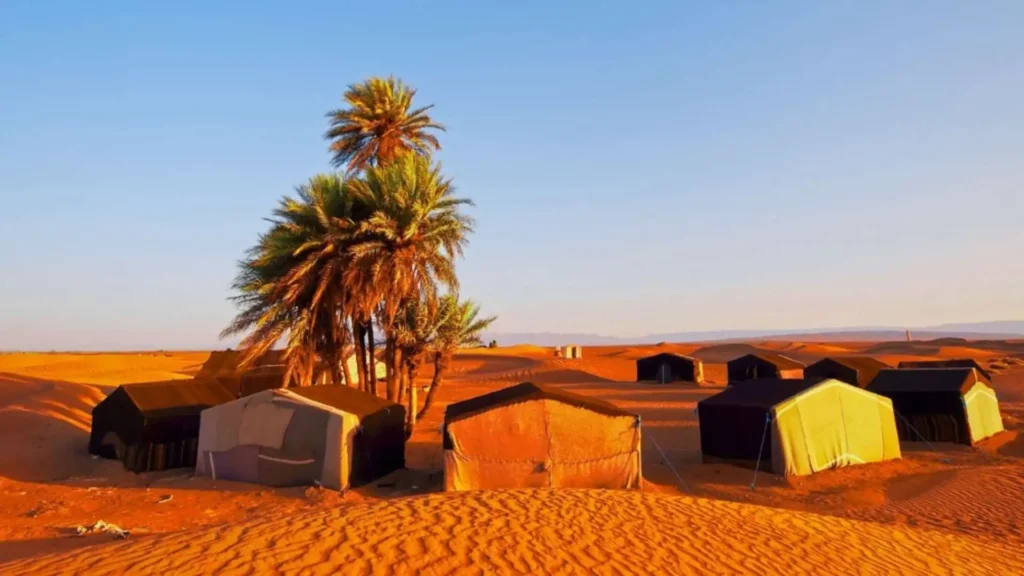
These target budget travelers or those who want the Sahara stripped bare. Tents are traditional black goat-wool Berber structures with simple beds. Bathrooms are shared and located separately. But what they lack in material comfort, they make up for with unforgettable social atmosphere: everyone gathers around the fire at night for traditional drumming and storytelling.
Prices: roughly €30–60 per person per night (dinner and breakfast included).
Merzouga Luxury Desert Camp — A Different World Entirely
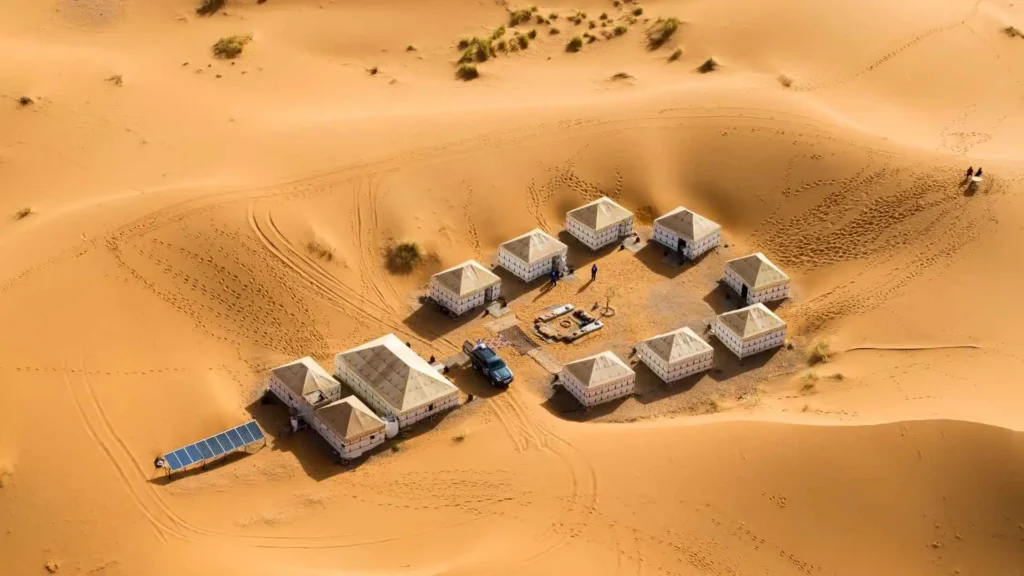
Here the equation shifts completely. Spacious canvas suites with elegant furniture, hotel-quality beds, and fine cotton linens. Each tent includes a private bathroom with a modern toilet and hot shower. Some advanced camps in Erg Chebbi offer air conditioning and electric blankets in winter.
The best luxury camps are positioned in isolated areas deep within the dunes to guarantee total privacy. Dinner is a multi-course affair blending Amazigh tagine with internationally inspired cuisine.
Condé Nast Traveler has placed select Moroccan desert camps on its global best-of lists. The luxury here isn’t about excess — it’s about the isolation of the setting and the quality of service.
Prices: €80–200 per person per night.
How to Choose the Right Camp
Don’t choose on price alone. Verify these essentials:
- Are bathrooms private or shared?
- Is the camp isolated or clustered near others (this affects the tranquility experience)?
- Read reviews on independent platforms carefully.
- If traveling in low season, confirm that other guests will be present during your stay.
What You’ll Actually Do: Activities Between Adventure and Contemplation
Morocco Camel Ride — The Classic Desert Experience
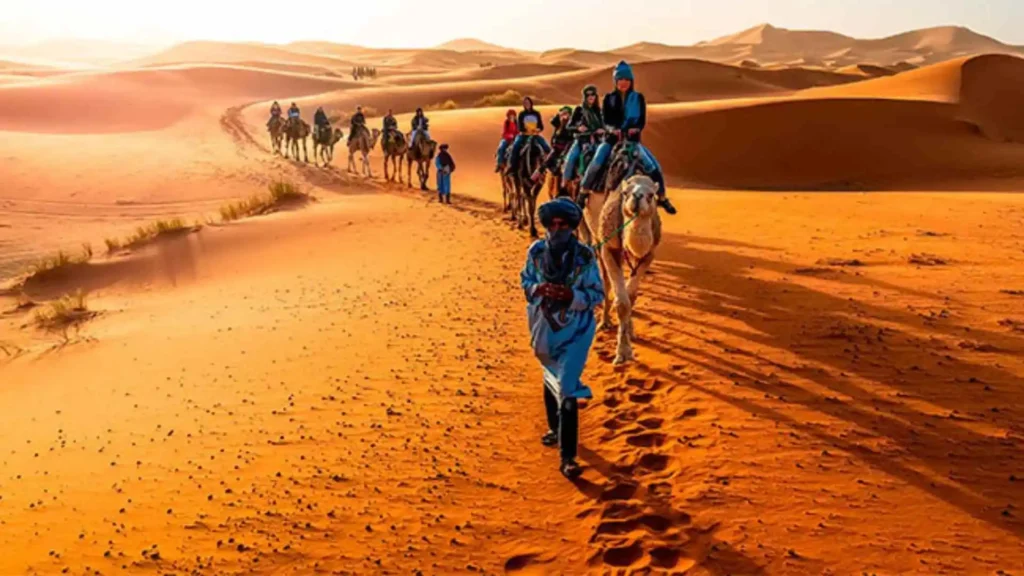
A camel ride in the Sahara desert is the one experience every traveler talks about long after they’ve returned home. The trek from the desert’s edge to camp typically takes one to two hours, crossing dunes under a sun that’s sliding toward the horizon. The view from atop a dromedary is fundamentally different from ground level — wider horizons and a sense of belonging to a caravan rooted deep in history.
A practical note: extended camel riding can strain your back and knees. Wear long, comfortable pants to avoid friction against the camel’s rough hide. If you get uncomfortable, don’t hesitate to dismount and walk alongside — many guides encourage it.
For those specifically heading to Merzouga, a camel trek into the Erg Chebbi dunes is one of the signature experiences of the entire country. The most popular option is an overnight camel trek from Merzouga to a desert camp nestled deep among the dunes, where you’ll sleep under a sky thick with stars.
Sandboarding Sahara Desert Morocco — Sand Surfing at Its Finest
If you’re after an adrenaline hit, sandboarding is a blast — available at most camps. You climb a towering dune and slide down on a board. It demands decent fitness for the repeated ascent through soft sand, but the fun is worth the effort.
Sand surfing Morocco’s golden dunes has been gaining serious popularity, particularly among younger travelers and content creators chasing distinctive footage. Whether you call it sand surfing, sandboarding, or desert surf, the thrill is the same. The cooler months (autumn and winter) are the best time for it, when the sand isn’t scorching hot underfoot.
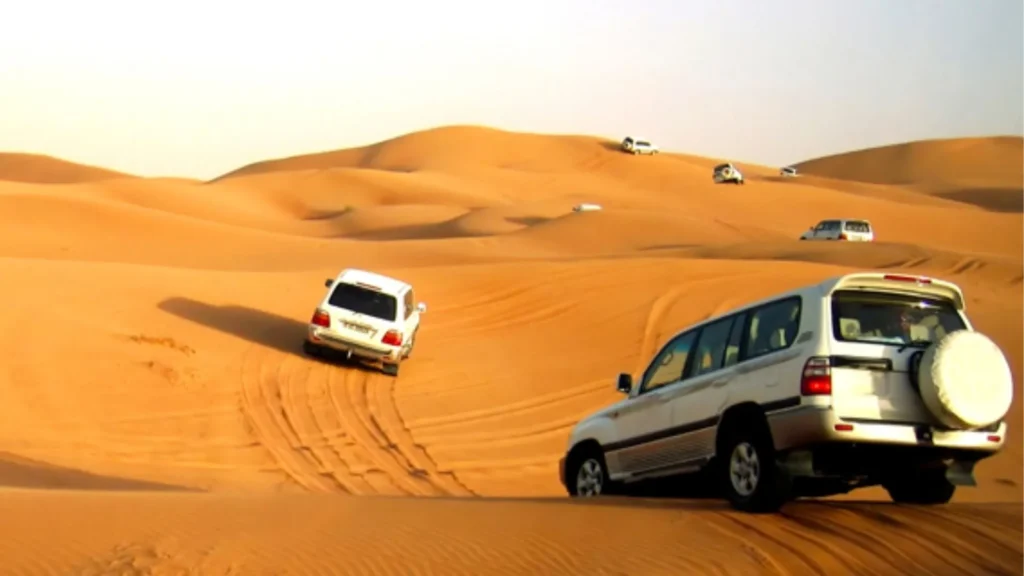
Quad biking delivers speed and adrenaline across varied desert terrain. And 4×4 desert safaris are the ideal way to explore rocky hamada landscapes, visit old phosphate mines, and meet genuine nomadic families in places no camel can reach.
Stargazing: A Sky Like Nowhere Else
This is what doesn’t get written about enough. With zero light pollution, the Moroccan Sahara sky at night defies description. The Milky Way is visible in staggering clarity with the naked eye. Some upscale camps offer telescopes and guided astronomy sessions, but honestly, all you need is a blanket on the sand and the willingness to look up.
One traveler put it simply: “The desert was stunning… climb the dunes in the evening and enjoy the stars. That image will stay with you forever.”
Experiences You Won’t Find in Any Brochure
Beyond the usual activities, these are the moments that create the real difference:
- Visit Khamlia village near Merzouga: home to communities of sub-Saharan African descent, famous for Gnaoua music — a spiritual tradition inscribed on the UNESCO Intangible Heritage list.
- Try fresh camel milk: many describe it as the desert’s natural energy drink — mineral-rich with a taste unlike anything else.
- Walk barefoot on the sand at dawn: before sunrise, the sand is cool and impossibly soft — a sensory experience that connects you to the earth in a primal, beautiful way.
- Stay two nights, not one: a single night means most of your time is spent traveling. The second night is where real stillness, real contemplation, and real connection with nomadic families happen.
Cultural Etiquette: What You Need to Know Before You Arrive
The Moroccan Sahara isn’t just a geographic space. It’s a cultural one, governed by codes of behavior passed down through centuries. Understanding them isn’t optional courtesy — it’s the key to authentic connection.
The Tea Ritual
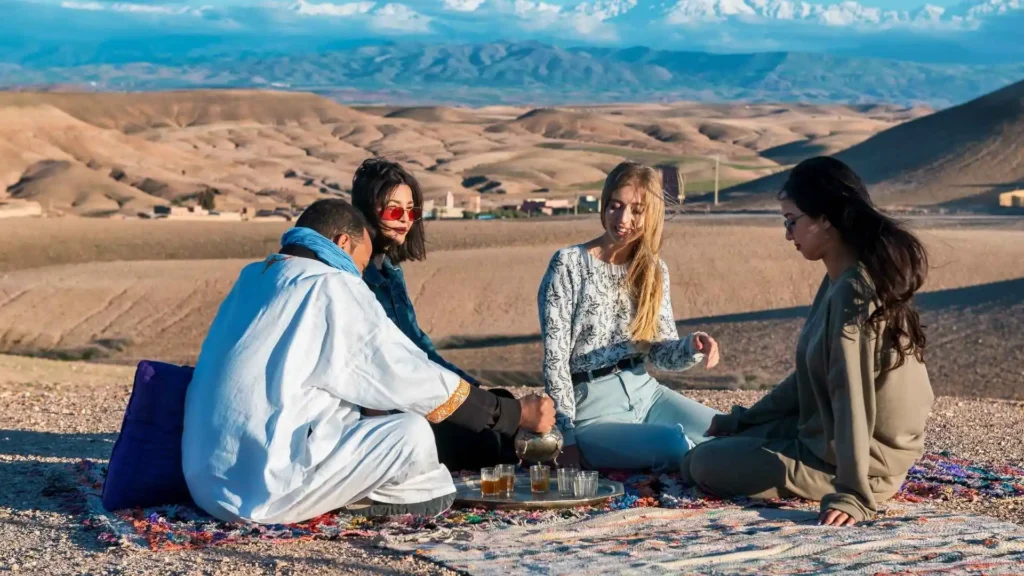
Mint tea is the “wine of the desert,” as its people call it. Refusing a glass can be read as unwillingness to engage. My advice: always accept the first cup with a smile, even if you’re not a tea person. You’ll notice that desert tea prepared by locals is stronger and foamier than city tea — the practical reason being that foam protects the tea from blowing sand.
Shared Meal Etiquette
In the desert, communal meals are a sacred tradition. Food arrives in a single central dish — usually tagine or couscous. The rule is simple: eat from the section directly in front of you and don’t reach into others’ zones. Always use your right hand for eating, handshakes, and exchanging money — this is a fundamental cultural norm across North Africa.
Dress Code in Desert and Rural Areas
While coastal cities are more relaxed, desert villages remain conservative. I’d advise all travelers — men and women — to cover shoulders and knees when visiting communities. Modest dress doesn’t just avoid discomfort; it opens doors to genuine connection with locals who appreciate the respect.
Photography and Privacy
Golden rule: never photograph people without permission. Especially women in villages and nomadic families. Smile, ask politely, and if they decline — respect it completely. Many locals are happy to be photographed once you’ve taken a moment to exchange a few friendly words first.
The Sahara in Literature and Cinema: A Journey Before the Journey
If you want to add depth to your trip, reading about the Moroccan Sahara before arriving will fundamentally change your experience.
Paul Bowles and the Existential Question
The American writer who lived in Tangier for decades drew a striking distinction in The Sheltering Sky between the “tourist” and the “traveler”: the tourist hurries home to the safety of civilization, while the traveler belongs entirely to the place they’re in — and may never return. The novel was adapted into a film by Bernardo Bertolucci, shot in the Moroccan Sahara. Watching it before your trip adds a whole new layer.
Ouarzazate — Morocco’s Hollywood
You may have watched a film shot in Ouarzazate without realizing it. From Lawrence of Arabia to Gladiator, from James Bond to Game of Thrones and Prison Break — this city has hosted an extraordinary number of global productions. Touring the Atlas Film Studios feels like traveling through cinema history, with Egyptian, Tibetan, and Roman sets sitting side by side.
Alice Morrison and the Modern Desert
For a contemporary, ground-level perspective, Alice Morrison’s Walking with Nomads documents her journey crossing Morocco on foot with camels. She captures the social changes in nomadic women’s lives and how modern education is reshaping the aspirations of younger generations in the desert — while the ancient value of absolute generosity endures.
Real Voices from the Sand: The Ahansal Brothers
Among the most compelling testimonies I’ve encountered is a conversation with Lahcen and Mohamad Ahansal — guides and world-class marathon runners born into a nomadic family in the Zagora desert. Lahcen won the Marathon des Sables — widely considered the toughest footrace on earth — ten times. Mohamad won it five times.
Lahcen recalls their childhood: “We ran through dunes and rocks from morning to night. We played football with balls made from torn t-shirts. We didn’t have much, but we were free.”
When they guide tourist groups today, they insist on one principle above all: respect for nature. “We teach them not to throw trash anywhere,” Lahcen says. “We always carry bags to collect waste. We don’t use polluting 4x4s to move in groups — we use camels. You have to lead by example.”
Mohamad chooses the Chigaga region as his favorite: “There are over 35 kilometers of dunes, and the nearest village is 100 kilometers away. You can truly enjoy the beauty of the sky and the stars.”
When asked for advice for first-time desert hikers, their answers are characteristically direct. Lahcen: “Always go well-equipped — sunscreen, good shoes, sunglasses, a cheche or hat.” Mohamad: “And always carry water. At least 1.5 liters. Even when it’s not too hot, the desert is very dry. You need to hydrate throughout the day.”
Your Practical Checklist: The Non-Negotiables
What to Pack
- High-SPF sunscreen
- Sunglasses and a cheche or head covering for sun and sand protection
- Lightweight long-sleeve clothing for daytime
- Warm layers for nighttime — temperature swings of 20°C between day and night are common
- Comfortable walking shoes (not brand new ones)
- Bottled water in sufficient quantity — stick to sealed bottles, even for brushing teeth in some areas
- Snacks for the long road journey
- Small coins — you’ll need them for restroom stops along the way
- A backpack rather than a large suitcase — vehicle space is limited
Water, Food, and Health
Stay hydrated constantly. A minimum of 1.5 liters per day is recommended even in winter — the desert air is extremely dry and causes dehydration before you feel it.
A useful note from experienced travelers: meals at desert camps are typically far superior to the tourist-trap restaurants where drivers stop along the road. If possible, carry snacks for the drive and wait until camp for a proper meal.
On Money and Negotiation
Across Morocco, and especially in tourist areas, bargaining is a natural part of the buying culture. Don’t consider it offensive — it’s a social interaction both sides enjoy. Negotiate with a smile and respect, and don’t push prices to unreasonable lows.
About Giving Money to Children
You’ll encounter children asking for money or sweets at the edges of villages. My advice — and most experts agree — don’t give money directly to children. It encourages them to skip school and beg from tourists. If you genuinely want to help, donate to local associations or village schools, or buy school supplies and give them through your local guide.
A Day in the Desert: Dawn to Stars
To bring it all to life, here’s what a full day looks like for those who’ve lived this experience:
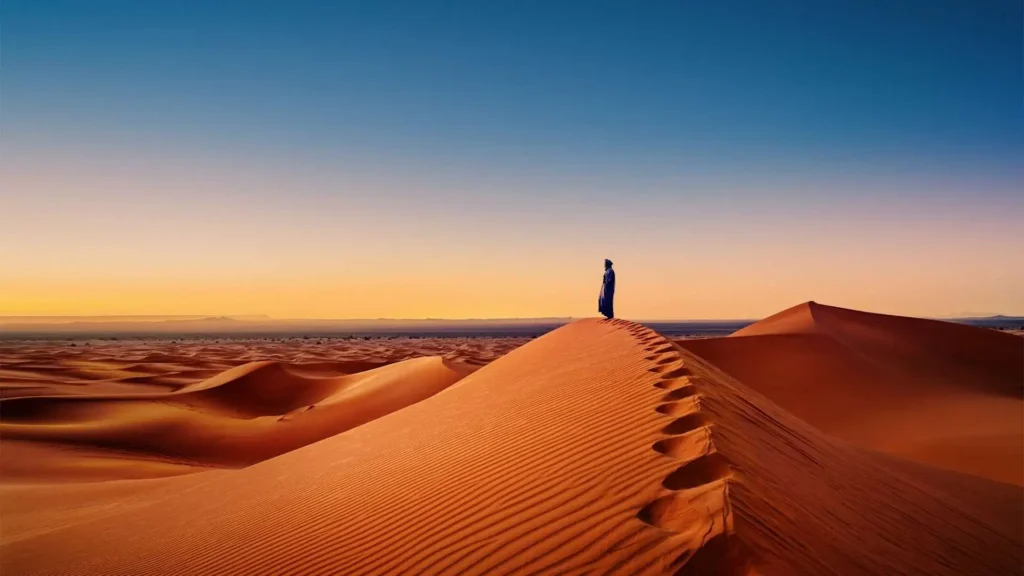
5:00 AM — You slip out of your tent before dawn. The sand is cool under your feet. You climb the nearest dune and sit in silence, waiting. Then it happens: a thread of orange light splits the horizon, and in minutes the dunes transform from dark gray to blazing gold. For breakfast, you taste fresh cheese made from camel’s milk — smooth, delicately salty.
1:00 PM — The sun is directly overhead. You shelter under an Amazigh tent and eat Moroccan soup with ember-baked sand bread.
4:00 PM — Time for the dromedary ride. Long sleeves and head covering are essential. You sway atop the camel through undulating dunes while your Amazigh guide tells you about the stars he’ll show you tonight.
6:00 PM — A stop at an oasis to drink mint tea under the shade of palms. The guide explains how water flows in the heart of the desert and how centuries-old irrigation systems still function.
7:00 PM — Dinner among the dunes. Medfouna — bread stuffed with spiced meat and baked in a pit under hot sand — or a vegetable tagine cooked the traditional Amazigh way.
9:00 PM — You lie back on a blanket over the sand. The fire crackles. Traditional drums pulse from the gathering circle. Then you lift your eyes to the sky — and you understand why people travel thousands of kilometers to be here.
Three Souvenirs Worth Bringing Home
When you leave, slip a piece of the desert’s soul into your bag:
- A cheche: the iconic Tuareg head wrap, traditionally worn for protection against sun and sand. Some measure up to 8 meters long.
- A fibula: a traditional gold or silver brooch favored by Tuareg women, worn pinned to clothing or as a pendant.
- Date-pit coffee: a unique caffeine-free beverage made from roasted, finely ground date pits — fruity, distinctive, and said to benefit the kidneys and liver.
Sustainable Travel: Our Responsibility to This Beauty
I can’t write about the Moroccan Sahara without addressing the challenges it faces. Tourism that depends on pristine natural beauty carries an inherent contradiction: its rapid growth can threaten the very beauty it relies on.
The water challenge is real. In a region suffering from increasing drought — where climate change has shrunk oasis areas and dried up stretches of the Draa River — the water consumption of tourism raises legitimate questions. The emerging trend favors eco-lodges that rely on water recycling technology and solar energy.
The noise issue matters too. The spread of quad bikes and fast vehicles among the dunes disturbs wildlife (like the fennec fox) and undermines the very silence most visitors are seeking. Local authorities have begun designating specific zones for motorized activities away from quiet camping areas — a step in the right direction.
As a traveler, you can contribute: choose operators committed to responsible practices, carry your waste out, prefer camels over engines where possible, support local artisans by buying directly, and if the opportunity arises, participate in oasis restoration initiatives.
Frequently Asked Questions
Is the Sahara Desert in Morocco?
Yes. The Sahara extends into southeastern Morocco, where you’ll find two major dune systems: Erg Chebbi near Merzouga and Erg Chigaga south of M’Hamid El Ghizlane. The Agafay Desert near Marrakech offers a rocky desert experience but is not technically part of the Sahara.
How far is the Sahara Desert from Marrakech?
Merzouga is approximately 560 km from Marrakech — about 8 to 10 hours by road. The route crosses the High Atlas via the Tizi n’Tichka pass at 2,260 meters. From Fes, the distance is shorter at around 460 km but still takes a full day with stops.
What is the best time to visit the Sahara Desert in Morocco?
Spring (March–May) and fall (September–November) offer the most comfortable temperatures, between 20°C and 30°C during the day. October is arguably the best single month. Avoid June through August when daytime heat exceeds 45°C.
What is the weather in Sahara Desert Morocco like?
It varies dramatically by season. Winter days are mild (15–25°C) but nights can drop near freezing. Spring and fall are ideal at 20–30°C. Summer is extreme, with daytime temperatures above 45°C. Night-to-day temperature swings of 20°C are common year-round, so layers are essential regardless of when you visit.
How many days do I need for a 3-day Sahara desert tour?
A 3-day tour from Marrakech to Merzouga covers the main highlights — Ait Benhaddou, Dades Valley, Todra Gorge, and one night in a desert camp. However, if time permits, a 4 to 5-day itinerary allows a much more relaxed pace and a second night in the desert, which most travelers consider the real highlight.
What are the best Sahara desert camps in Morocco?
Camps range from standard (shared bathrooms, communal meals, €30–60/night) to luxury (private en-suite bathrooms, multi-course dinners, €80–200/night). For Erg Chebbi, look for camps that are positioned deep in the dunes for maximum privacy and silence. Always check reviews on independent platforms before booking.
Is glamping in Sahara Desert Morocco worth it?
Absolutely. A Merzouga luxury desert camp combines the raw beauty of the Sahara with genuine comfort — private tents, quality bedding, hot showers, and gourmet meals. The experience of waking up in a well-appointed tent surrounded by nothing but golden dunes is unlike any hotel stay.
Can I go sandboarding in Sahara Desert Morocco?
Yes. Sandboarding is available at most camps near Erg Chebbi. You climb a dune and slide down on a board — it requires good fitness for the repeated ascent through soft sand. The best months for sand surfing are autumn and winter when the sand is cooler.
How much does a Merzouga camel trek cost?
A standard sunset camel trek to a Sahara desert camp in Morocco typically costs between €10 and €30 per person, often included in multi-day tour packages. Longer overnight camel treks with camping deep in the Erg Chebbi dunes are also available at higher prices.
What are the best hotels near the Sahara Desert in Morocco?
In Merzouga, accommodations range from budget guesthouses to luxury kasbahs positioned at the edge of Erg Chebbi. Many offer direct access to the dunes and can arrange camel rides, 4×4 excursions, and desert camp stays. Camel rides in Morocco remain one of the top-rated activities for visitors, and most hotels will handle the booking for you. Reserving in advance is recommended during peak seasons (March–May and September–November).
What are the Sahara desert tours from Morocco like?
Most tours depart from Marrakech or Fes and last 3 to 5 days. They typically follow a route through the Atlas Mountains with stops at Ait Benhaddou and the Dades and Todra gorges before reaching the desert at Merzouga or M’Hamid. You can choose between budget group tours, private 4×4 journeys, or fully customized itineraries with luxury Sahara desert camping along the way.
Final Word
The Moroccan Sahara, with its shifting sands and fixed stars, isn’t just a travel destination — it’s a mirror. It reflects a stillness you’ve forgotten in the noise of city life, and it reorders your priorities in a way no other journey quite manages. The Ahansal brothers, who’ve conquered the world’s toughest marathons, say the desert is their “school” — the place that taught them that “from small things, you can make great ones.”
Maybe that’s the deepest lesson you’ll bring home: you don’t need much to feel full. A hot cup of tea, a sky with no edges, and a silence that sounds like music — that’s all it takes. And the Sahara in Morocco gives you all of that and more, provided you walk across its sands with steps that respect the earth and honor those who’ve called it home for thousands of years.
Read also: