Let me save you hours of scrolling through contradictory forum posts and outdated blog articles. If you’re travelling to Morocco as an unmarried couple, here’s what nobody tells you upfront: the experience depends almost entirely on who you are, where you stay, and how well you understand the gap between Moroccan law on paper and Moroccan life in practice.
Having spent years covering Morocco’s tourism landscape—interviewing hotel managers, digging through penal codes, and following the political debates that shape hospitality policy—I can tell you that Morocco is one of the trickiest balancing acts in the Mediterranean. A deeply traditional Muslim-majority nation that also happens to be the number one tourist destination in Africa, welcoming nearly 20 million visitors in 2025 alone. That tension between heritage and openness is exactly where your questions live, and I’m going to walk you through every single one of them.
Table of Contents
What Moroccan Law Actually Says About Unmarried Couples
First, the facts. Article 490 of the Moroccan Penal Code criminalizes sexual relations between a man and a woman outside of marriage. The penalty ranges from one month to one year in prison. That’s the law, and it hasn’t changed—even after the revised penal code was issued in December 2025.
Now, before you close this tab and cancel your flights, hear me out.
Proving a violation of Article 490 requires either catching someone in the act or obtaining a judicial confession. Police don’t raid hotel rooms looking for foreign tourists without wedding rings. Prosecutions under this article are almost exclusively directed at Moroccan citizens, and usually in contexts that have nothing to do with tourism—domestic disputes, neighborhood complaints, or situations involving commercial sex work.
For foreign visitors, Article 490 is effectively a dead letter. That’s not my opinion. In 2024, Morocco’s own Minister of Justice, Abdellatif Ouahbi, publicly declared that hotels demanding marriage certificates from guests was an “illegal practice” and “an intrusion into people’s private lives.” He challenged anyone to produce a written law requiring it. Nobody could.
So yes, the law exists. No, it won’t affect your vacation. But the nuances matter, and they depend on your specific situation.
Read also: Can You Drink Alcohol in Morocco? What Every Tourist Needs to Know in 2026
Can Unmarried Couples Share a Hotel Room in Morocco?
This is the question that floods every travel forum, and the answer is refreshingly simple—if you’re both foreign nationals.
Foreign couples (neither partner is Moroccan)
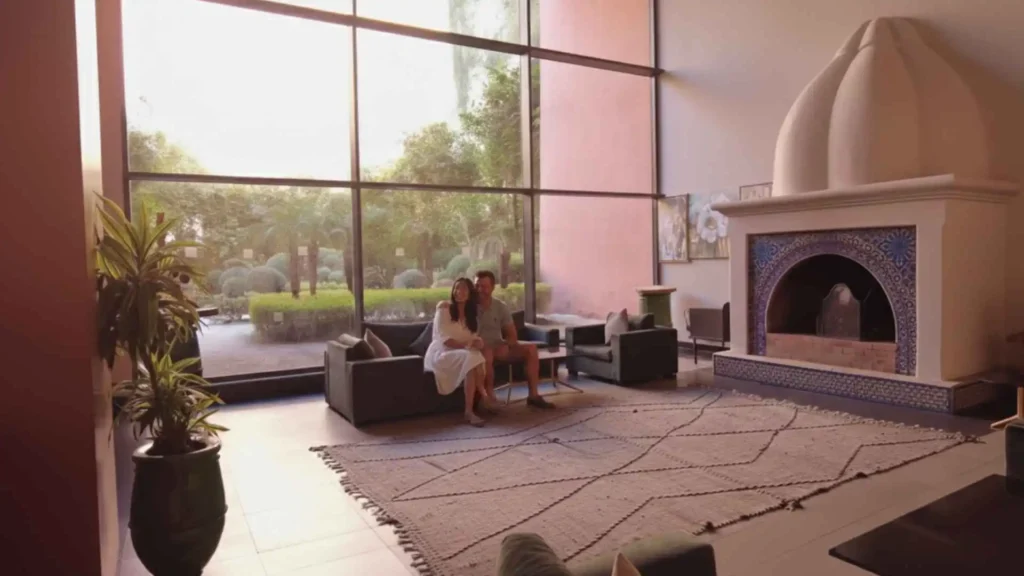
You will have zero issues. The vast majority of classified hotels, international chains like Marriott, Hilton, and Sofitel, as well as the charming riads scattered through the old medinas, will check you in without a single question about your marital status. You’ll hand over your passports—standard security procedure for all guests—and receive your room key. That’s it.
In major tourist cities—Marrakech, Agadir, Essaouira, Fes, Casablanca—hotels have been welcoming unmarried foreign couples for decades. It’s routine. It’s expected. It’s not even a conversation.
Read also: Honeymoon in Morocco 2026: The Lalla Laarousa & Moulay Sultan Guide
Binational couples (one partner is Moroccan)
This is where things get complicated. The moment a Moroccan ID or passport appears at the front desk, local regulations kick in. Most hotels will refuse to give you a shared room without an official marriage certificate. And they’re not being difficult—they’re protecting themselves from potential criminal liability for “facilitating immorality” under Moroccan law.
Some dual citizens try using their foreign passport (French, American, Canadian) to sidestep the issue. It works more often than not, but it’s a gamble. If your Moroccan origins are discovered, you’re treated as a local citizen in the eyes of the law.
Moroccan couples (both partners are Moroccan)
Sharing a hotel room without a marriage certificate is simply not an option. This rule is enforced consistently across the country.
Is Morocco Safe for Unmarried Couples? Here’s What Safety Actually Looks Like
Let’s reframe this question, because “safe” can mean a lot of things.
If you’re worried about being arrested, detained, or harassed by police for being an unmarried foreign couple—don’t be. Moroccan law enforcement does not target foreign tourists over Article 490. The police have far bigger priorities, and the country’s entire economic strategy depends on making visitors feel welcome.
If you’re worried about social judgment, here’s the reality: Morocco is not a monolith. Marrakech is not a rural village in the Atlas Mountains. The coastal resort towns are not the conservative interior. In tourist-heavy areas, locals have seen every combination of travelers imaginable, and they genuinely don’t care about your relationship status.
Where you might feel some friction is in very remote, deeply conservative rural areas where small guesthouses may ask about marriage—not because they’re enforcing the law, but because that’s the social norm in their community. The solution? Stick to established tourist corridors for accommodation, and you won’t encounter this.
A Detail Most Guides Skip: Arab Tourists Face Extra Scrutiny
If you’re visiting from another Arab country—the Gulf states, Egypt, Tunisia—you should know that you may receive more scrutiny at hotel check-in than a European or American couple would. The reason is straightforward: your appearance may resemble local Moroccans, and some hotel staff might default to applying domestic rules.
My advice: choose internationally branded hotels (4 or 5 stars), and make your foreign passport clearly visible from the start. That alone usually resolves any ambiguity before it becomes an issue.
Morocco Hotel Options for Unmarried Couples: Where to Stay and What to Expect
Riads: privacy with Moroccan character
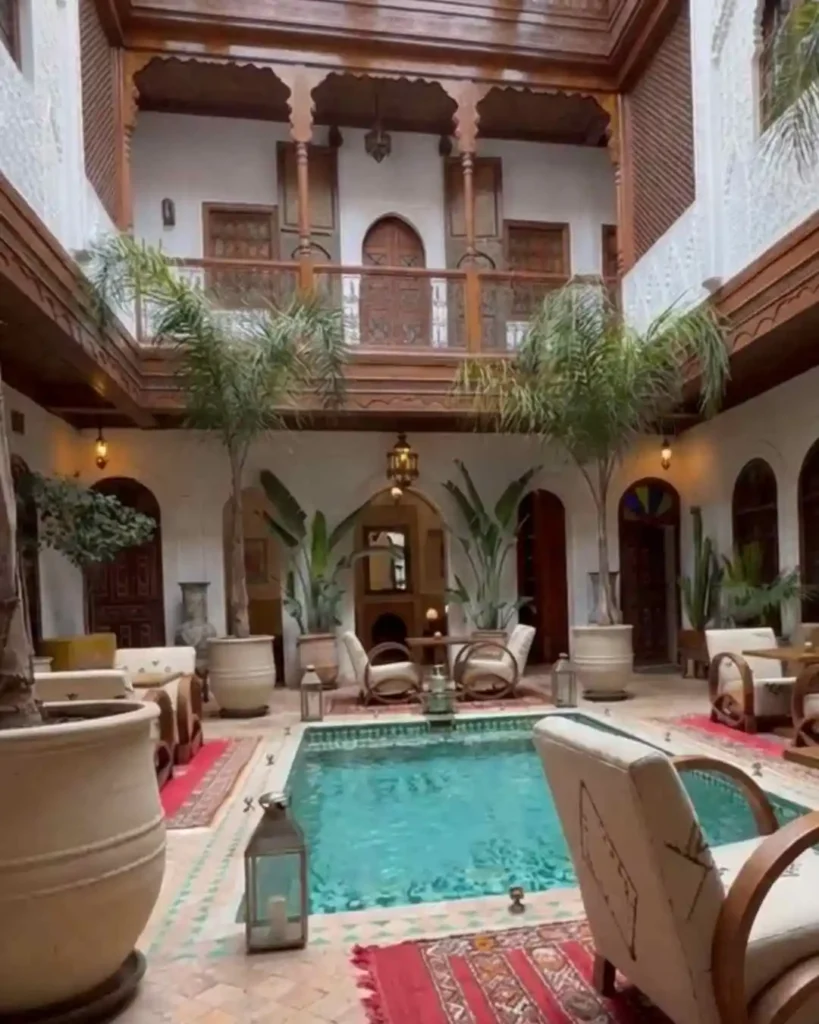
Riads—traditional courtyard houses converted into boutique guesthouses—are among the best options for couples seeking both privacy and authenticity. Many are operated by foreign expats or Moroccans deeply accustomed to international guests. The atmosphere is intimate, discreet, and nobody is going to interrogate you about your personal life.
International hotel chains
Marriott, Hilton, Sofitel, Accor properties—they follow global protocols. Your relationship status is irrelevant to their check-in process. If peace of mind is your top priority, these are a safe bet.
Airbnb in Morocco: does it allow unmarried couples?
Airbnb works in Morocco, and it’s a popular choice for travelers who prefer independence. However, there’s a legal layer you should understand. Moroccan hosts are required by law to register all guests with local security authorities through what’s known as the “Fiche de Police”—a guest registration card. For foreign couples, this is usually a non-issue. But if one partner is Moroccan, it can create complications.
Also worth noting: not all Airbnb hosts in Morocco operate with proper tourism licenses, which means the level of legal protection varies.
Facebook Marketplace and Avito: the unofficial rental market
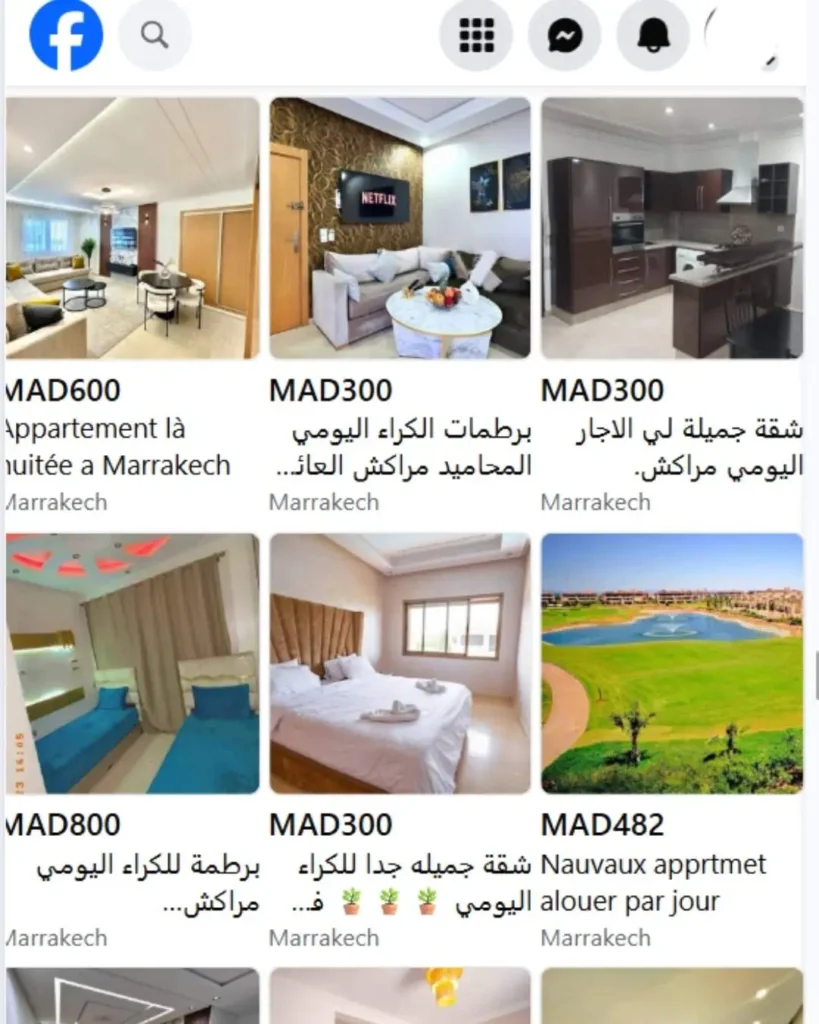
Here’s something most travel blogs won’t mention. There’s a thriving informal market for daily furnished apartment rentals through Facebook Marketplace and Avito (Morocco’s largest classifieds platform). You’ll find plenty of listings at competitive prices, and some landlords openly cater to unmarried couples—Moroccan and foreign alike.
I’ll be straight with you: most of these rentals operate outside the legal framework. The landlords typically don’t hold tourism exploitation licenses and don’t register guests with the police as required by law. Countless Moroccans use these services daily without incident, and many foreign visitors do too. But you should understand what you’re getting into—no insurance, no legal guarantees, and no official recourse if something goes wrong.
Do people use them? Constantly. Would I recommend them as your first choice? No. Licensed hotels and riads offer a level of security and accountability that informal rentals simply can’t match.
Morocco Rules for Couples: Public Behavior and Cultural Etiquette
Morocco is famously hospitable, but it’s also a society that values what locals call “hshuma”—a sense of modesty and propriety in public spaces. Understanding this cultural code will make your trip significantly smoother.
Public displays of affection
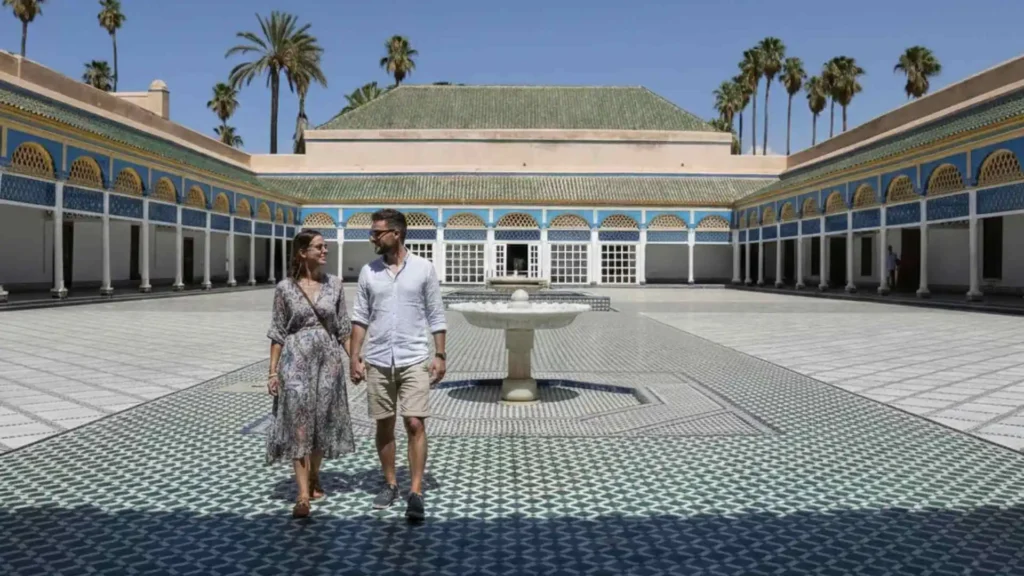
Holding hands, a light arm around the shoulder, a quick peck on the cheek—all perfectly fine in tourist areas. Passionate kissing, heavy physical contact in the street, or anything overtly sexual near mosques or in conservative neighborhoods? That will draw stares, disapproval, and potentially a visit from the tourism police.
The rule of thumb: behave as you would in any respectful public setting anywhere in the world. You’re not being asked to hide your relationship—just to read the room.
Dress code
Morocco doesn’t impose a dress code on tourists. But modest clothing—especially when visiting traditional souks, religious sites, or rural areas—reduces unwanted attention and earns you respect from locals. During Ramadan, extra sensitivity goes a long way: avoid eating, drinking, or smoking in public during daylight hours, and keep physical affection more subdued than usual.
Dealing with curiosity and hustlers
Someone might casually ask about your relationship with your travel companion. The easiest response? Refer to your partner as “my husband” or “my wife.” You’re not obligated to explain your life choices to a shopkeeper, and this simple shortcut saves you from conversations you didn’t sign up for.
In cities like Marrakech, you may encounter unofficial “guides” who try to exploit your situation as an unmarried couple to intimidate or extort you. Stay calm, decline firmly, and if anyone crosses a line, head straight to the nearest tourism police post. Moroccan authorities take harassment of tourists extremely seriously—and that’s not a cliché, it’s an observable fact.
Is Morocco Safe for Gay Couples?
I owe you honesty on this one. Article 489 of the Moroccan Penal Code criminalizes same-sex relations with penalties of up to three years in prison. Unlike Article 490 (which applies to heterosexual unmarried couples and is effectively unenforced against foreign tourists), Article 489 has not been as clearly exempted for foreigners.
The practical reality: Morocco is not overtly hostile on a day-to-day basis, but public displays of affection between same-sex partners will attract unwanted attention and could create genuinely uncomfortable situations. LGBTQ+ travelers who visit Morocco typically do so with considerable discretion in public, choosing accommodations that maximize privacy.
It’s not the answer anyone wants to hear, but it’s the honest one. Know the landscape, assess your comfort level, and make your own informed decision.
Read also: Is It OK to Travel to Morocco in 2026? Safety Facts Beyond the Stereotypes
The 2030 World Cup Factor
There’s one development that’s likely to reshape Morocco’s tourism policies in the coming years. The country is preparing to co-host the 2030 FIFA World Cup alongside Spain and Portugal—an event that will bring millions of fans from every culture and background imaginable. The infrastructure, regulations, and hospitality norms will need to accommodate that diversity at a scale Morocco has never experienced before.
Minister Ouahbi’s 2024 statements about hotel marriage certificate requirements are widely read as early signals of a shift toward a more flexible, internationally aligned approach to hosting foreign visitors. Whether this translates into formal legal changes remains to be seen, but the direction of travel is clear.
Frequently Asked Questions
Can unmarried couples stay in Morocco without any problems?
Yes, if both partners are foreign nationals. You can book and share hotel rooms, riads, and vacation rentals in all major tourist areas without being asked for a marriage certificate. The only situation where real difficulties arise is when one or both partners hold Moroccan citizenship.
Do Moroccan hotels ask for a marriage certificate?
The overwhelming majority of classified hotels and international chains do not ask foreign couples for proof of marriage. Some smaller, locally-oriented guesthouses in non-tourist areas might, but this is increasingly rare—especially after the Justice Minister’s 2024 public statement declaring the practice unlawful.
What are the laws in Morocco for unmarried couples?
Article 490 of the Moroccan Penal Code technically criminalizes sexual relations outside marriage. However, this law is virtually never enforced against foreign tourists. Prosecutions target Moroccan citizens and typically arise from specific complaints, not from hotel stays or tourist activities.
Can you go to Morocco as an unmarried couple if one partner is Moroccan?
This is the most challenging scenario. Hotels will almost certainly require a marriage certificate if a Moroccan ID is presented. Dual citizens sometimes use their foreign passport to navigate this, but the workaround carries risk. If you’re in this situation, plan ahead—either carry official marriage documentation or book separate rooms.
Does Airbnb allow unmarried couples in Morocco?
Airbnb itself has no restrictions on unmarried couples. However, individual Moroccan hosts must comply with local laws, including guest registration with police. For foreign couples, this is rarely an issue. For binational couples, it may depend on the host’s willingness to navigate the legal gray area.
The Bottom Line on Travelling to Morocco as an Unmarried Couple
Travelling to Morocco as an unmarried couple is not the minefield that anxious forum posts make it out to be—at least not if you’re both foreign visitors. The country’s tourism industry is mature, experienced, and quietly pragmatic. Choose your accommodation wisely, show basic respect for local customs in public spaces, and you’ll find Morocco to be one of the most welcoming, vibrant, and memorable destinations you’ve ever visited.
If your partner is Moroccan, the equation changes, and preparation becomes essential. The legal framework hasn’t caught up with the country’s cosmopolitan ambitions—not yet, anyway.
But for the millions of international couples who visit each year, Morocco delivers exactly what it promises: extraordinary beauty, legendary hospitality, and an experience that stays with you long after you’ve come home.
Note: Some illustrative images in this article were edited using AI.
Read also: