For roughly five years, anyone walking along the Bouregreg waterfront would have noticed it: a low, white, sculpted structure that didn’t look like anything else in Rabat — or, frankly, anywhere else in Morocco. Tourists snapped photos and asked their guides what it was. The guides usually gave the same answer. “It’s a theatre. It’s not open yet.”
That changed on April 22, 2026. Princesses Lalla Khadija, Lalla Meryem, and Lalla Hasnaa attended the opening of the Royal Theatre of Rabat to the general public, alongside Brigitte Macron, the wife of the French president. The event closed out a wait that started the moment construction wrapped in 2021. If you’re planning a trip to the Moroccan capital this year — and especially if you’re chasing the country’s emerging cultural circuit — this is the building that wasn’t on any itinerary as recently as a few weeks ago.
Two things are worth stating upfront. The Royal Theatre is now the largest performing arts venue in Africa and the Arab world. And it carries the signature of the late Iraqi-British architect Zaha Hadid, who died in 2016 before seeing it finished.
Table of Contents
A Building Twenty Years in the Making
The story begins in 2010, when King Mohammed VI personally invited Hadid — the first woman to win the Pritzker Prize, in 2004 — to design a major theatre in his capital. There was no architectural competition. The selection was direct. Hadid signed the contract on November 5 of the same year with the Bouregreg Valley Development Agency, the public body charged with transforming the riverbanks into a modern cultural and commercial district.
Construction officially began in October 2014, as part of an ambitious royal program titled “Rabat, City of Light, Cultural Capital of Morocco.” The original delivery date was 2019. That deadline came and went.
What slowed the project was the design itself. Hadid had built her career on what computational designers call parametric architecture — geometries so complex they can only be calculated by algorithm. Translating those forms from screen to concrete required a level of fabrication precision Morocco hadn’t attempted before. Then Hadid died unexpectedly in March 2016. Her firm, led by Patrik Schumacher, finished the work. Then COVID-19 hit. The building was technically completed in 2021 but stayed sealed off from the public for another five years while programming and management were sorted out.
The final cost: 1.677 billion Moroccan dirhams, roughly $170 million — well above the initial €120 million budget. The structure covers 27,000 square meters of built area on a seven-hectare riverside site. Internationally, the project is sometimes referenced as the Grand Theatre of Rabat, the name used by Zaha Hadid Architects and most foreign press; locally and officially, it’s the Royal Theatre.
What the Building Actually Looks Like
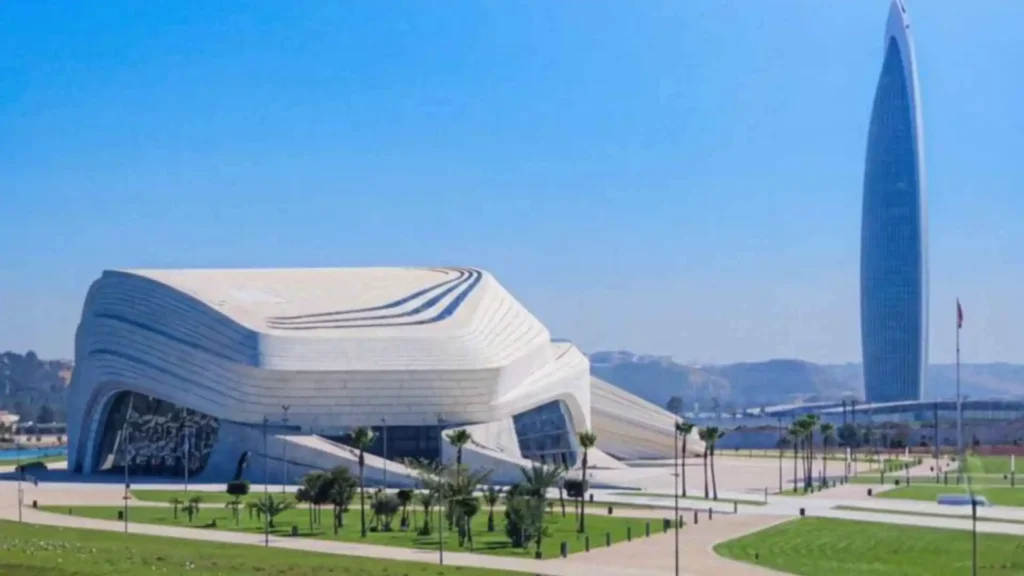
The first thing that registers when you stand in front of the Royal Theatre is the absence of straight lines. There isn’t a single sharp corner anywhere on the exterior. Every surface curves into the next, as if the building had been poured rather than built.
This was Hadid’s calling card. Critics called her the queen of curves — sometimes meant as praise, sometimes not. Here, she drew her forms from two sources: the meandering bends of the Bouregreg River, and the calligraphic flourishes of Arabic script. The exterior is wrapped in panels of glass-fiber reinforced concrete, a material that allows complex sculpted shapes without an underlying steel frame, and that holds up to the African sun without yellowing or cracking.
The whiteness shifts depending on the hour. Mid-morning it reads as cold and clinical. By midday it’s nearly blinding — bring sunglasses. Around sunset, the GRC panels catch the orange and pink of the sky and act almost like a screen. After dark, interior lighting bleeds through the foyer’s glass walls and turns the whole building into a lantern over the river.
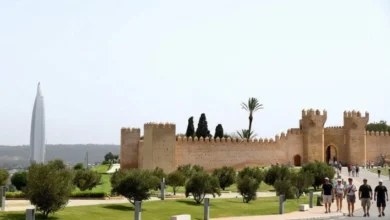
The location is intentional. The theatre faces the Hassan Tower, the unfinished 12th-century minaret of the Almohad dynasty, and the adjacent Mohammed V Mausoleum. Just north sits the Mohammed VI Tower, currently the tallest building in Africa. Few cities in the Arab world stage this kind of architectural conversation between a 12th-century ruin and a 21st-century landmark. Rabat does it within walking distance.
Inside: A Hall Inspired by Moroccan Muqarnas
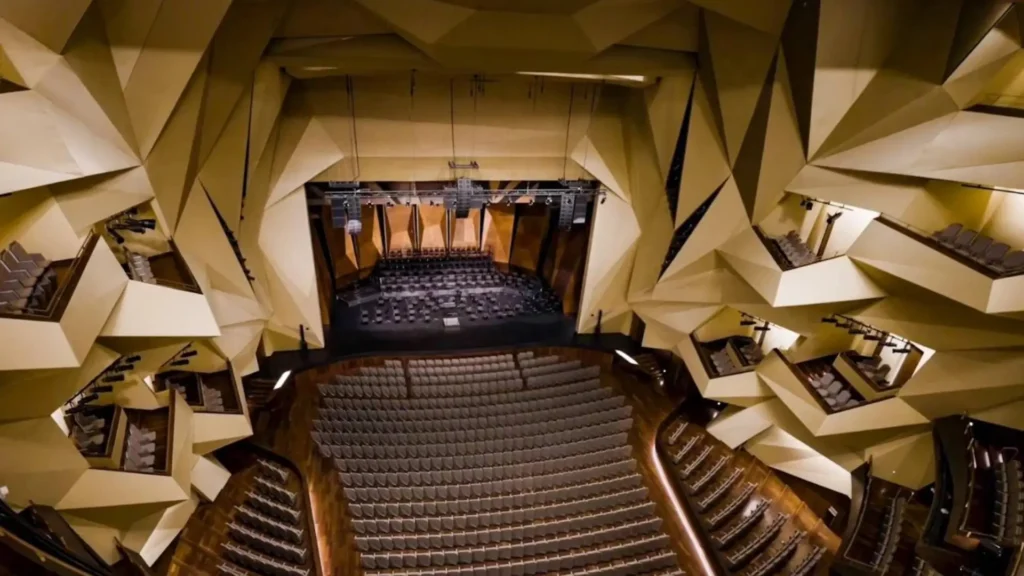
The interior contradicts the exterior, deliberately. Where the outer skin flows in continuous curves, the main auditorium uses a faceted, crystalline geometry inspired by muqarnas — the stalactite-like vaulting that decorates the ceilings of traditional Moroccan mosques and madrasas.
The result is an 1,800-seat hall, including 20 spaces designated for visitors with reduced mobility. What makes it stand out, though, isn’t the seat count. It’s the acoustic engineering, handled by Arup, the British firm responsible for some of the most acoustically refined performance spaces of the past three decades. The ceiling carries adjustable sound reflectors that recalibrate the room depending on what’s being performed — opera, symphony, ballet, or straight theatre. The orchestra pit is hydraulic, capable of accommodating up to a hundred musicians or rising to extend the audience floor.
Engineers built the hall using a “box-in-box” design. The auditorium itself is structurally separate from the building’s outer shell, suspended on isolation systems that absorb vibration. Translation: traffic noise from the riverside boulevard, wind, and nearby construction never reach your seat.
What You’ll Find on Site
Calling this place a “theatre” undersells it. The site functions as a small cultural complex with several distinct spaces, and not all of them require a ticket to enter.
The main auditorium seats 1,800 and hosts the headline international and national programming.
The secondary hall seats 520 and is used for experimental work, intimate concerts, panel discussions, and public workshops. Tickets here are typically cheaper — and harder to come by. Locals figured this out fast.
The outdoor amphitheatre holds up to 7,000 people and is built into the landscape so the Hassan Tower stays visible on the skyline. This is where Rabat’s larger festivals are expected to land, including Mawazine, the city’s flagship world music festival.
The panoramic restaurant is the part most foreign visitors miss in their planning. It seats 350 and stays open outside performance hours. The view spans both banks of the Bouregreg, the Hassan Tower, and the Mohammed VI skyscraper. You don’t need a performance ticket to dine here, and reservations are strongly recommended on weekends.
Dressing rooms, rehearsal studios, and creative spaces for performers occupy the back of house. These aren’t accessible to the public, but their presence signals what kind of company the venue is built to host.
Programming for 2026: Who’s Performing
The artistic direction has been handed to Brahim El Mazned, appointed Deputy General Director and Artistic Director shortly before opening. El Mazned isn’t a new figure in Moroccan cultural life — since 2004, he’s run the Timitar Festival in Agadir, one of Africa’s largest world music gatherings, which has drawn over 380,000 attendees in a single edition.
The opening night featured around 100 Moroccan artists performing classical works and original national compositions, conducted by the rising Moroccan maestra Dina Bensaid. The programming slate for the months ahead leans heavily on classical music — symphonic concerts with the Philharmonic Orchestra of Morocco and the Royal Symphony Orchestra — alongside opera, ballet, and musical theatre. The outdoor amphitheatre is expected to host Mawazine festival sets later in the year.
Ticketing logistics are still settling. As of writing, the most reliable path is to monitor the official channels of the theatre and the Bouregreg Valley Development Agency. Tickets generally release three to six weeks before each performance. For international travelers, advance booking is essential — early demand has been strong.
How to Get to the Royal Theatre of Rabat
The location works in foreign visitors’ favor. The theatre sits in the Grande Place of the Bouregreg riverbank, at the meeting point of three of Rabat’s most important districts: Hassan, the Kasbah of the Udayas area, and Salé across the river.
Tram: The most efficient option. The closest stations are “Tour Hassan” and “Pont Hassan II,” each a ten-minute walk from the theatre entrance. The Rabat-Salé tram is clean, runs frequently, and a single fare costs six dirhams (about 60 cents).
Taxi: From Agdal or central Rabat, the ride takes 10 to 15 minutes and rarely exceeds 25 dirhams in a small (red) petit taxi. Make sure the driver runs the meter.
On foot: If you’re staying near the parliament or central Avenue Mohammed V, plan on a 25 to 35-minute walk through Bab El Had square and down toward the river. It’s a pleasant route, mostly flat, and runs through some of Rabat’s better-preserved colonial-era streets.
A Day Plan: The Theatre and What’s Around It
Don’t visit the Royal Theatre as a stand-alone stop. Build a full day around it.
Morning (9:00 AM – noon): Start with the Hassan Tower and the Mohammed V Mausoleum, directly across from the theatre. The tower is the unfinished minaret of what was meant to be the largest mosque in the Islamic world when construction halted in 1199. The mausoleum next to it holds the tombs of King Mohammed V and King Hassan II, and the red-uniformed royal guards are part of the experience.
Midday (noon – 2:30 PM): Walk to the Kasbah of the Udayas, the 12th-century Almohad fortress overlooking the Atlantic. Wander the blue and white alleys, order mint tea at Café Maure with a view of the river mouth, and don’t skip the small Andalusian gardens.
Afternoon (2:30 – 5:00 PM): Lunch in the Rabat medina, then browse the souks for textiles, leather, or Moroccan silver. Prices here are noticeably lower than in Marrakech, and the haggling is gentler.
Evening (5:00 – 7:00 PM): Head to the theatre. Arrive at sunset for the best photos of the white facade catching the last light. Dine at the panoramic restaurant.
Night: If you’ve booked a performance, you’re set. If not, the riverside walk after dark is one of Rabat’s underrated pleasures.
Read also: Best Time to Visit Morocco 2026: The Answer Starts With Where, Not When
Practical Notes for Foreign Visitors
The dress code inside the theatre leans semi-formal. No tie required, but shorts and beachwear will feel out of place. Professional cameras are restricted during performances. Phones must be silenced. Children under six are admitted only to programming designed for them.
For language: French and Arabic are the working tongues, but the theatre’s front-of-house staff handle English without trouble. Signage is multilingual. Visitors from Arabic-speaking countries will have no friction at all.
One more thing worth flagging: Rabat is the UNESCO World Book Capital for 2026. That designation runs the full year and brings a parallel calendar of literary festivals, exhibitions, and cultural events across the city. The timing of the theatre’s opening with this title isn’t a coincidence — it’s strategy. If you’re visiting Rabat in 2026, you’re visiting at a genuinely unusual moment in the city’s modern history.
FAQ: The Royal Theatre of Rabat
What exactly is the Royal Theatre of Rabat?
It’s a performing arts complex on the banks of the Bouregreg River in Morocco’s capital, designed by Zaha Hadid and opened to the public on April 22, 2026. It’s the largest theatre in Africa and the Arab world.
Can I visit the building from the outside without a performance ticket?
Yes. The exterior plazas and gardens are open to the public, and you can photograph the building freely. The panoramic restaurant also operates outside performance hours.
What’s the difference between the Royal Theatre and the Mohammed V National Theatre?
The Mohammed V National Theatre, in central Rabat, has operated since 1962 and primarily hosts local theatre productions. The Grand Theatre is a new, internationally-scaled venue with much higher capacity and acoustic engineering, designed to host major touring productions.
Are guided tours of the building available?
Not officially as of opening. Theatre management has indicated guided tours are in the works. Check the official website for updates.
Where should I stay near the Grand Theatre of Rabat?
The most luxurious option is the Waldorf Astoria inside the Mohammed VI Tower, minutes from the theatre. More moderately priced hotels in the Hassan and Riyad neighborhoods are also nearby and well-connected by tram.
Read also: