She was nineteen, newly married, and on a steamer headed for Tangier. The year was 1959, and Paula Wolfert had no plan beyond following her husband to a city that, in her own words, would end up shaping her entire adult life. What she didn’t know — couldn’t have known — was that she would return to Tangier three separate times over the next seventeen years, that she would spend the next six decades writing almost exclusively about Moroccan food, that food critics would crown her “the queen of Mediterranean cooking,” and that the late New York Times food writer Craig Claiborne would call her “one of the finest and most influential cookbook authors in this country.”
Wolfert herself would later put it more simply. Tangier, she wrote, was where she “found my vocation as food writer — where I discovered who I really was.”
I understand the sentiment. Because Morocco isn’t a country you eat — it’s a country you absorb, with all five senses simultaneously.
What follows is not the standard travel-blog roundup. It’s a long, honest, deeply researched walk through one of the oldest living cuisines on the planet. I’m not going to recite forty must-try dishes the way every other site does. I’m going to explain why the food tastes the way it does, where every flavor came from, how to spot the real thing versus the watered-down tourist version, and exactly where to go to eat unforgettably.
Settle in. This isn’t a five-minute read. This is the guide you’ll come back to before your trip, during it, and when you’re telling your friends about it after.
Table of Contents
In One Sentence: What Is Moroccan Food?
Moroccan food is the result of two thousand years of layering — Indigenous Amazigh traditions, Arab and Islamic influence, Andalusian refugees fleeing 1492, sub-Saharan trade caravans, Sephardic Jewish communities, and a French colonial chapter — fused into a cuisine built on three pillars: tagine, couscous, and mint tea, and three philosophies: cook slowly, serve generously, eat together.
You’ll find versions of that sentence in every guidebook. The story behind it is far richer.
Why Moroccan Food Has Become a Global Phenomenon
In July 2024, British chef Gordon Ramsay announced on Instagram that Moroccan cuisine had been crowned “the world’s best” in a Pubity poll. Pubity itself confirmed that Moroccan cuisine took 60% of the votes against Mexican cuisine in the final round, garnering more than 2.5 million votes overall — the platform’s biggest “you decide” contest at the time.
But the recognition that matters most didn’t come from a social-media poll. It came from UNESCO. In December 2020, the knowledge, know-how, and practices surrounding the production and consumption of couscous were inscribed on the Representative List of the Intangible Cultural Heritage of Humanity, in a joint dossier filed by Morocco, Algeria, Tunisia, and Mauritania. The Argan tree, the cherry festival of Sefrou, the Jemaa el-Fna square in Marrakech, and the practices around date palm cultivation had already made it onto UNESCO lists.
We’re not talking about “delicious food,” then. We’re talking about a complete cultural ecosystem that humanity has formally agreed to protect.
There’s more. National Geographic devoted a 2026 feature to Morocco within its annual Culinary Collection, opening with a line that’s hard to argue with: “Morocco — a country synonymous with melt-in-the-mouth tagines and couscous fragrant with vibrant spices — offers no shortage of culinary adventures.”
The Roots: Where These Flavors Actually Come From
To understand why a tagine tastes the way it does — why sweet meets savory in a single dish without anyone batting an eye — you have to go back in time.
The Amazigh Layer: The Land and the Clay Pot
Morocco’s Indigenous people, the Amazigh, have lived on this land for thousands of years. They are the inventors of both the tagine and couscous. The word couscous itself derives from the Tamazight seksu, meaning “well-formed” or “finely rolled.” Couscoussiers — the steaming vessels still used today — have been excavated at the archaeological site of Igiliz in the Sous Valley, dating back to the 12th century.
The tagine, similarly, is a creature of the mountains. Picture an Amazigh woman in the High Atlas a thousand years ago, needing a way to cook meat with as little water as possible (water was scarce) over the gentlest charcoal flame. So she created this clay vessel with its conical lid that traps rising steam, condenses it on the inner walls, and returns it to the food as droplets. That isn’t a cooking method. That’s survival genius dressed up as cuisine.
The Arab-Islamic Layer: Spices and the Sweet-Savory Marriage
With the 7th-century Islamic conquest, the Abbasid culinary tradition arrived in Morocco — itself heavily Persian-influenced. Eastern spices came with it: cinnamon, ginger, saffron, caraway. So did the philosophy that distinguishes Moroccan food from every other Mediterranean cuisine: mixing sugar with meat. That fingerprint — visible in lamb tagine with prunes, in pastilla, in tfaya couscous — traces back to Persian Abbasid cooking that reached the Maghreb through Andalusia.
The Andalusian Layer: Refugees Who Brought a Whole Cuisine
In 1492, Granada fell. Over the centuries that followed, hundreds of thousands of Andalusian Muslims and Jews fled into Moroccan cities — Fez, Tetouan, Rabat, Chefchaouen — carrying with them the memory of the refined urban cuisine that had flourished in Córdoba and Seville. They introduced olives and citrus, paper-thin pastry sheets (warqa), and the entire infrastructure of the bastilla (or pastilla). When you taste a properly made Fassi tagine today, you’re tasting 15th-century Granada.
The African and Saharan Layer: Dates and Trade-Route Spices
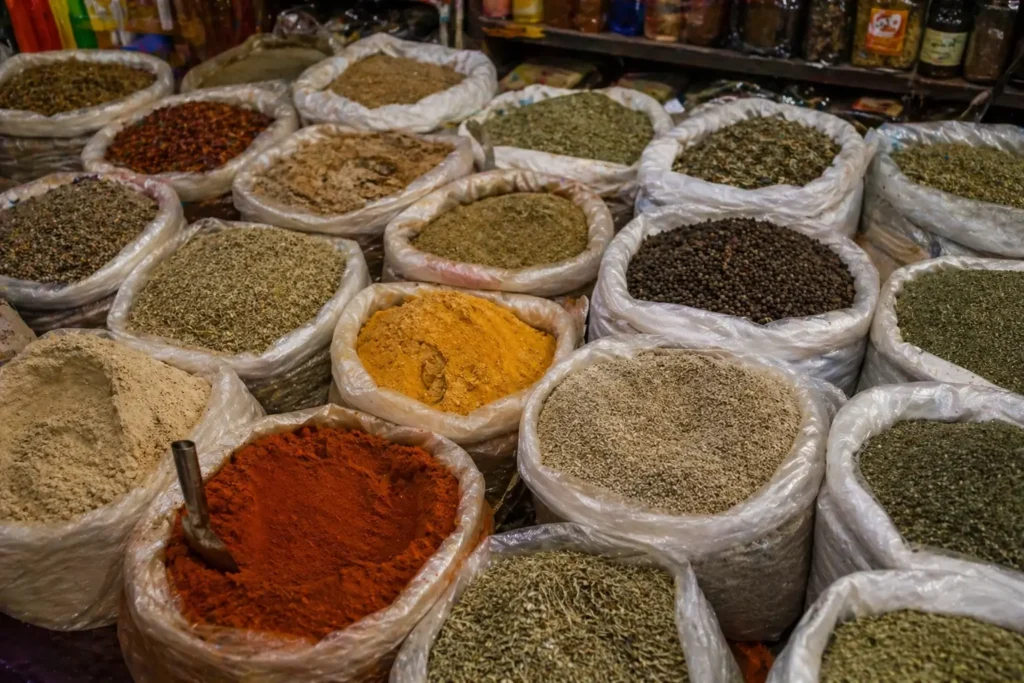
From south of the Sahara came caravans loaded with gold, dates, and exotic spices. Cities like Sijilmasa, Zagora, and Tamegroute were the gateways of that trade. Dates — now protected on UNESCO’s heritage list — are a purely Saharan inheritance. The famously complex spice blend known as ras el hanout can include up to 27 different ingredients, some of which originated in Equatorial Africa, as documented in Wolfert’s The Food of Morocco.
The Jewish Layer: A Cuisine on the Brink of Disappearing
For centuries, Morocco was home to a substantial Jewish population, particularly in Fez, Marrakech, Tetouan, and Sefrou. That community produced a parallel cuisine of striking originality: skhina (or dafina), the Sabbath stew slow-cooked overnight; the Sephardic haroset of dates, almonds, and walnuts. Much of this heritage is now endangered, but Wolfert documented it carefully in The Food of Morocco — one of the few comprehensive English-language records that survives.
The Big Three: Famous Moroccan Dishes You Can’t Skip
Let me be honest with you. You’ll be drowning in lists of “30 must-try Moroccan dishes” or “50 traditional Moroccan recipes.” That’s not a useful way to plan a trip. Here are the three pillars, then a handful of additions that actually deserve your stomach space.
1. Moroccan Food Tagine: The Dish That Became the Country’s Symbol
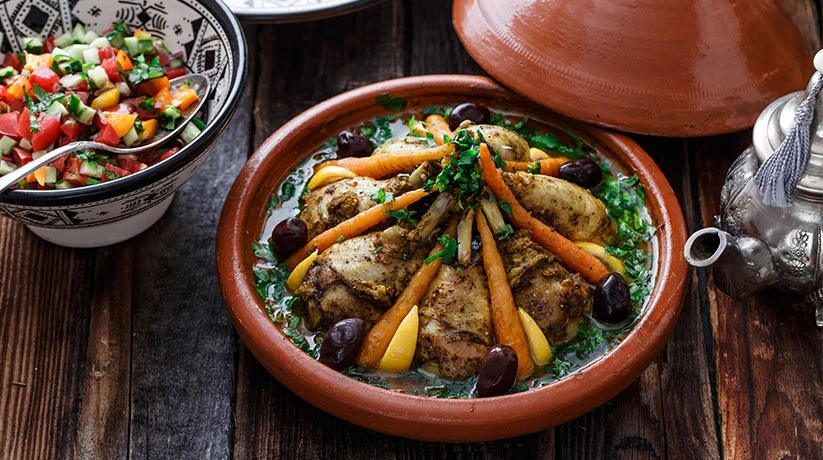
The word tagine refers simultaneously to the vessel and the dish. The vessel is a flat earthenware base topped by a tall conical lid, traditionally cooked over slow charcoal heat for hours. That cone isn’t decorative. Its geometry captures the steam rising from the meat and vegetables, condenses it on the inner walls, and lets it drop back as flavored droplets. That’s why properly cooked tagine meat is so tender — almost no added water, no diluted flavor.
The classics worth ordering:
- Chicken tagine with preserved lemon and olives — the gold standard. Concentrated citrus tang, soft meat, briny olives.
- Lamb tagine with prunes and almonds — the most famous example of the sweet-savory marriage. Two hours, minimum.
- Fish tagine with chermoula — a coastal specialty, especially in Essaouira and Agadir, where fish is marinated in chermoula (cilantro, parsley, garlic, cumin, paprika, lemon, olive oil) before slow-cooking with vegetables.
- Kefta tagine with eggs — a humbler, common-table dish: meatballs in tomato sauce, with eggs cracked in near the end.
Insider note: A real tagine cannot be ready in fifteen minutes. If yours arrives that fast at a tourist-strip restaurant, it’s been pre-cooked and reheated. The genuine version is either ordered in advance, or cooked over a visible charcoal brazier you can watch from the street. In Fez, and along the side alleys behind Jemaa el-Fna in Marrakech, you’ll see tagines bubbling on coals in the open. That’s the real thing.
2. Couscous: The National Dish and the Friday Ritual
In nearly every Moroccan household — and I mean nearly every — couscous is prepared on Friday. After the midday prayer, extended families gather around a single large platter set in the middle, and everyone eats from it: with a spoon, or in many homes, by rolling small balls of couscous in the right hand. This ritual is close to sacred.
Real couscous takes hours. The grains are hand-rolled in traditional homes, then steamed three separate times over a broth of meat and vegetables in a vessel called a couscoussier, with light sprinkles of water and olive oil between steamings. That’s what gives you the loose, fluffy texture in which every grain stays separate. The “five-minute couscous” sold in cardboard boxes back home is, technically, an insult to the original.
The varieties run deep:
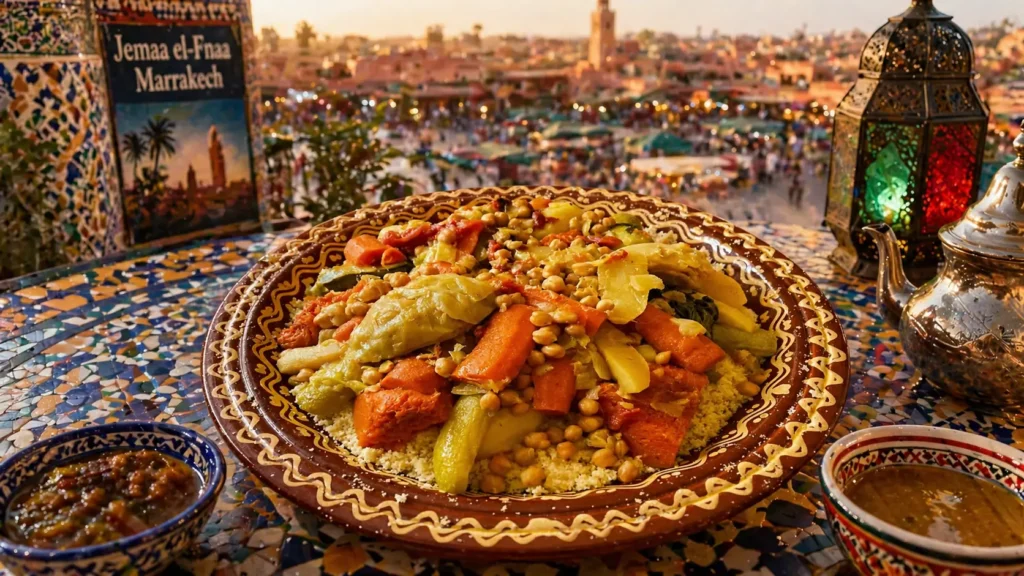
- Couscous with seven vegetables — the most familiar version: a colorful arrangement of carrots, turnips, cabbage, zucchini, pumpkin, chickpeas, and chard, served with beef or chicken.
- Couscous with tfaya — caramelized onions, raisins, and cinnamon. The sweet-savory thing again.
- Fish couscous — coastal specialty (Essaouira, Agadir).
- Pumpkin couscous — autumnal.
- Barley couscous (couscous belboula) — a rural Atlas version, served with buttermilk.
3. Pastilla: A Piece of Andalusia on a Plate
If a single dish encapsulates the Moroccan philosophy of fusing sweet and savory, it’s pastilla. National Geographic described it as “the conical pie filled with pigeon, eggs, spices, and almonds, fried until golden.” Traditionally made with squab, today it’s most often made with chicken, more rarely with seafood.
Pastilla is the test piece of any serious Moroccan cook. The paper-thin sheets — warqa — are made by hand, primarily in Fez and Tetouan. The filling is chicken slow-cooked with caramelized onion, cinnamon, and saffron, mixed with beaten eggs and toasted almonds. The whole thing is dusted with powdered sugar and cinnamon. The first bite is a small, beautiful shock: you expect savory, the sweet hits you, both work.
The best pastilla in Morocco is found in the traditional riads of Fez and Marrakech — and, when you’re lucky, in the homes of families who’ve been making it the same way for four generations.
A Map of Moroccan Food by City: What to Eat, Where
One of the biggest mistakes travelers make is treating Moroccan food as a single national menu. It isn’t. Each region has its own gastronomic personality. Here’s a working map.
Fez: The Spiritual Mother of Moroccan Cuisine
Fez is universally referred to as Morocco’s capital of taste. Its pastilla is the gold standard. Here you’ll find dishes you’ll struggle to find elsewhere: tagine kemama (layered with onions, tomato, and raisins), and rfissa (chicken with shredded msemen, lentils, and fenugreek — traditionally prepared after childbirth). Fez is also the city of refined sweets: kaab el ghazal (gazelle horns), fekkas, and briouats with almond paste.
Practical tip: Head to the Aachabin souk in Fez el-Bali to taste bissara — Morocco’s split-pea or fava-bean soup — prepared the traditional way, where the beans are mashed with a long wooden pole the size of a baseball bat. National Geographic documented the price at 15 dirhams a bowl, roughly £1.15 / $1.50.
Marrakech: The City of Tangia and Street Food
Marrakech is a working city, and its cuisine reflects it. The iconic dish here is tangia marrakchia — beef or lamb spiced with preserved lemon, garlic, and saffron, sealed inside a tall amphora-shaped clay pot (also called a tangia) and buried overnight in the ashes of the traditional public bathhouse furnace. The result: meat that falls apart at a glance. Historically, this was the bachelor laborer’s dish, dropped off in the morning and collected at night.
Then there’s Jemaa el-Fna — the UNESCO-listed square at the heart of the city. After sundown, it transforms into one of the world’s largest open-air restaurants: hundreds of food carts serving boubbouche (snails in herbed broth), maakouda (fried potato cakes), sfenj (Moroccan doughnuts), and freshly squeezed orange juice that costs you pocket change.
In the old Jewish quarter — the Mellah — you’ll find the city’s best spice merchants. According to Wolfert, this remains one of the better places to source authentic saffron and ras el hanout at fair prices, away from the marked-up tourist stalls.
Tangier: Mediterranean Gateway, Spanish Echo
Tangier is a port city. Its cooking centers on fresh fish and carries clear Spanish accents — the legacy of decades of Spanish presence in northern Morocco. Its singular street specialty is calentita (locally pronounced kalinté): a baked chickpea-flour cake with eggs, cumin, and olive oil, sliced and sold hot from carts. This is the dish that defines Tangier’s street food. I’d argue it deserves your stomach more than another generic tagine.
Essaouira: Atlas Mountains with Their Feet in the Atlantic
Essaouira — the white-and-blue port town — does seafood and only seafood, and it does it brilliantly. The fish tagine is here. So is mark hzina, the simple tomato and caper salad that Wolfert calls “the most refreshing salad in Morocco in summer.” Corn-couscous with seafood is local specialty. Walk down to the fishing port in the late afternoon: the fishermen themselves grill freshly caught sardines on charcoal, and they cost almost nothing.
Chefchaouen and the Rif: Mountain Food and Aged Cheese
In the Rif mountains, you’ll find a harder, older cooking: bissara made from dried fava beans with olive oil, and klila — the aged goat cheese that Wolfert calls “a mountain treasure.” Chefchaouen itself is famous for its almond vendors, who roast and candy them on the spot.
Agadir and the South: Argan Country
In southern Morocco, you enter the kingdom of argan oil — the tree that grows nowhere else on Earth. Liquid gold, the locals call it. Argan oil flavors many southern dishes: amlou (a spread of argan oil, ground almonds, and honey), couscous variants, and salads. The south is also the home of saffron — 90% of Moroccan production comes from Taliouine, a small mountain town at 1,100 meters where saffron is hand-harvested every morning in November before the sun warms the crocus blooms and dissolves their fragrance.
Moroccan Spices: The Hidden Engine of the Cuisine
Ask any Moroccan cook about the secret of the cuisine, and they’ll point at the spice rack. The classical Moroccan palette — as documented by serious culinary writers including Wolfert and Jeff Koehler — includes cinnamon, cumin, turmeric, ginger, paprika, coriander, saffron, caraway, cloves, fennel, anise, nutmeg, chili, fenugreek, and black pepper.
But the headline act is ras el hanout — literally, “head of the shop”: the merchant’s finest blend. It can contain a dozen spices or thirty. As Claudia Roden — the James Beard Award–winning food writer whose Arabesque is one of the most respected English texts on the cuisine — describes it in her book, Morocco offers “the most exquisite and refined cuisine of North Africa,” distinguished by its layered tagines, multilayered pies, and the marriage of meat with fruit.
Practical advice: don’t buy ras el hanout from the tourist-strip stalls. When you’re walking the medina with a knowledgeable local guide, ask to be taken to a real attar (spice merchant) in a residential neighborhood. In Marrakech specifically, the Mellah holds the city’s most professional spice traders at fair prices.
As for saffron: counterfeiting is rampant. Travelers are routinely sold turmeric-dyed filaments. Buy real saffron only in Taliouine itself or from verified merchants. Authentic Moroccan saffron costs roughly €4–7 per gram, but a single gram lasts a household for months.
Atay: Not a Drink — a Language
On my first trip to a Moroccan family home in the Atlas, I learned the rule the hard way: refusing the tea is an offense.
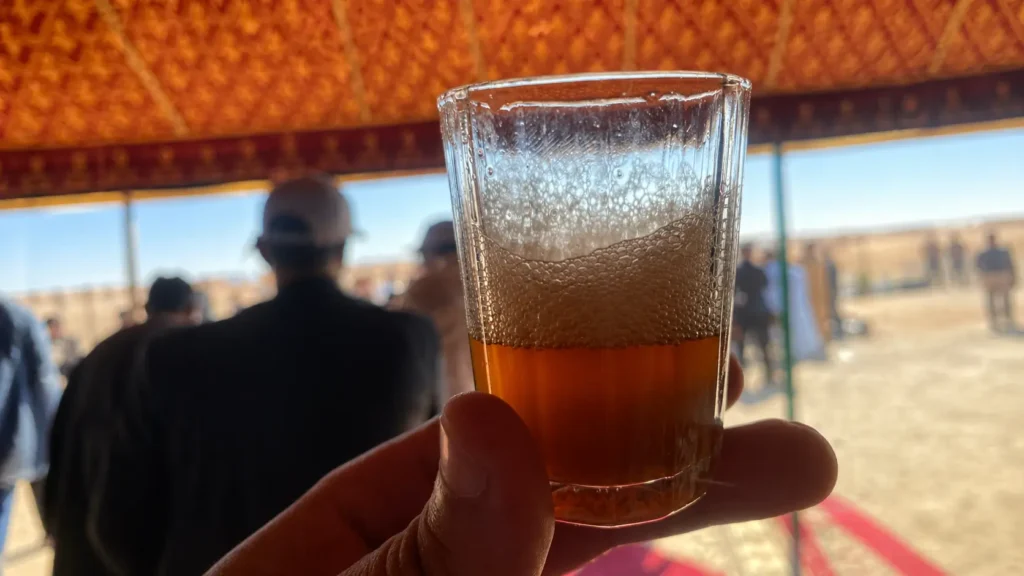
Atay — Moroccan mint tea — isn’t served because you’re thirsty. It’s a declaration of welcome, a gesture of hospitality, a marker of respect. National Geographic notes that “tea has been a sacred part of Moroccan culture for millennia.” Some claim the Amazigh imported the leaves from China; others say Queen Anne sent tea to Sultan Moulay Ismail in exchange for British prisoners. Either way, it’s been here long enough to feel native.
The brewing is itself a ritual. Green tea — the so-called Chinese gunpowder is the most familiar variety, though some households use other green teas — combined with generous fresh mint and a substantial amount of sugar, all heated in a metal teapot called a berrad, then poured from a height of nearly a foot above the glass to create the signature crown of foam. The cycle is repeated two or three times to blend the flavors.
Variations are everywhere. In the Rif, wild thyme is added. In the south, sometimes a few saffron threads. In summer, some households swap mint for chiba (wormwood), fliyou (pennyroyal), or lemon verbena. Along the coast and in some rural areas, sage or oregano. Morocco doesn’t have one mint tea recipe. It has dozens.
The first glass, the guest must accept. The second and third are tradition too. There’s an old Maghrebi saying: “The first is bitter as life. The second is strong as love. The third is gentle as death.” Translation: don’t gulp. Drink it across the three rounds.
Moroccan Dining Etiquette: What You Need to Know Before Sitting Down
The single most common question I get from foreign readers preparing to visit: “Will I embarrass myself at the table?” Answer: probably not. But a little knowledge goes a long way.
The basics:
- Take off your shoes when entering a Moroccan home unless your host explicitly says otherwise.
- Wash your hands. A bowl and a pitcher of water will be brought to you both before and after eating. This isn’t optional — it’s part of the ritual.
- Eat with your right hand only, especially when sharing from a communal platter. The left hand is traditionally considered unclean.
- Say “Bismillah” (“in the name of God”) before starting. It’s a small acknowledgment of the household’s traditions. Say “Alhamdulillah” when you’re done.
- Don’t eat from across the platter. Each diner eats from the slice of the platter directly in front of them. Imagine the dish quartered, and stay in your quarter.
- Bread is your fork and spoon. You tear pieces and use them to scoop tagine, or to lift bites from the central dish.
- Leave a little food in your bowl when you finish. It signals that the host has fed you well. A completely empty plate can, in some homes, suggest the opposite.
Moroccan Street Food: Is It Safe? Yes — If You Know Where to Go
It’s a fair question, and here’s the honest answer: yes, Moroccan street food is generally safe, and sometimes safer than tourist-trap restaurants where the food has been reheated three times.
Simple rule from the inside: if locals are eating somewhere, you can eat there. Look for the carts surrounded by Moroccans. Skip the ones surrounded only by tourists with cameras.
What’s worth your stomach space:
- Boubbouche (snails) — they look intimidating, then you taste the broth: more than fifteen herbs and spices (thyme, anise, black pepper, licorice root, parsley) simmered into a remarkable medicinal soup. Healthy, delicious, cheap. Find them at Jemaa el-Fna in the evenings, and in Fez.
- Sfenj — Moroccan doughnuts. Yeasted dough rings deep-fried, dipped in sugar, eaten in the morning with mint tea. Some vendors string them together so you can carry them home.
- Maakouda — fried mashed-potato fritters. A Fez specialty. Eaten in bread with a slick of harissa.
- Grilled sardines — at Essaouira’s and Agadir’s fishing ports. Caught in the morning, grilled in the afternoon.
- Calentita (kalinté) — Tangier’s chickpea cake, mentioned earlier. Found nowhere else.
- Harcha — semolina bread cooked on a flat iron, sold hot with butter, honey, or fresh white cheese.
- Bissara — fava-bean soup. A breakfast staple in winter. A bowl for less than a dollar.
The Daily Rhythm: When Moroccans Actually Eat
To get the most out of your trip, sync with the local meal cadence:
- Breakfast (6–10 a.m.): varied. Could be msemen (a folded, layered, butter-rich flatbread close in spirit to paratha), baghrir (semolina pancakes punctuated with a thousand tiny holes, sopping up honey and butter), harcha, melwi, or simply bread with olive oil, honey, amlou, and butter. Mint tea or, especially in Meknes, spiced coffee.
- Lunch (1–3 p.m.): the main meal of the day. Tagine territory, or couscous on Fridays. Most shops close between 1:00 and 3:30. The country takes a small breath.
- Tea time (5–6 p.m.): mint tea with simple sweets — chebakia, kaak, fekkas. A serious social ritual, particularly in family settings.
- Dinner (8–10 p.m.): usually lighter than lunch. Harira (the famous tomato-lentil-chickpea soup, especially central in Ramadan), salads, a light tagine, sandwiches.
During Ramadan, this rhythm flips. No food or water from dawn to sunset, then the evening iftar (always launched with harira, dates, and sweets), then long, sociable nights. If your trip lands during Ramadan, you’ll experience Morocco at its most communal — but you should plan for the altered schedule.
How to Eat the Real Morocco: Four Simple Principles
After everything above, the question that lingers is the right one: how do you make sure you’re eating the actual cuisine, not the diluted travel version?
The answer isn’t a hidden address book. It’s a mindset, plus four working principles.
First, read the menu before you sit down. Restaurants offering menus in four or five languages, with a glossy photo for every dish, are aimed at the passing tourist. That’s not necessarily bad — but it’s rarely the real thing. The places where Moroccans actually eat have menus in Arabic, perhaps French, and prices that match a local salary.
Second, time is the tell. Moroccan cooking is slow by nature. A real tagine is two hours minimum. A tangia takes overnight. Couscous needs multiple steamings. If a “traditional” dish reaches your table in ten minutes, it has been reheated. Order something that demands time, and wait for it.
Third, ask for the local specialty before the national classic. In Tangier, order the calentita before the tagine. In Agadir, ask for seafood couscous. In Tetouan, the kataif. Each region has signatures it does better than anyone. Tagine is everywhere — but everywhere isn’t necessarily where you should eat it.
Fourth, accept the invitation if it comes. The best meal you’ll have in Morocco won’t be in a restaurant. It will be in a family’s home, perhaps through a local friend or one of the platforms now organizing home-cooked dinners. Don’t hesitate. That single experience will return more value than the rest of the trip combined.
The Lebanese-born chef and James Beard Award winner Anissa Helou observed in Café Morocco that Moroccans “eat in the streets out of necessity rather than laziness or greed, and they expect the food to resemble what they have at home.” The only difference, Helou notes, is that street food is cooked by men, and home food by women. It’s a sharp observation — and it explains why street food in Morocco isn’t a substitute for home cooking. It’s its public extension, made with different hands.
Why People Come Back to Morocco for the Food
What makes moroccan food great isn’t simply the spice cabinet, or the variety of dishes, or the UNESCO listings. It’s something harder to capture: this is a cuisine that refuses to be eaten alone. The tagine sits in the middle. Hands reach in. Bread is torn and passed. Tea is poured. Conversation moves. Eating in Morocco isn’t fueling the body — it’s a communal act of presence.
When you go, don’t just eat. Participate. Accept an unexpected invitation. Sit on a cushion on the floor. Tear bread with a stranger. Drink tea across the three rounds.
And when you go home, you’ll quietly understand why Paula Wolfert spent sixty years writing about this cuisine. Because it’s worth it. It always was.
Frequently Asked Questions About Moroccan Food
What is typical Moroccan food like for a first-time visitor?
Typical moroccan food revolves around three centerpieces: tagine, couscous, and bread. Expect slow-cooked stews layered with spices (cinnamon, cumin, ginger, saffron, paprika), abundant fresh herbs, preserved lemon, olives, and the unmistakable sweet-savory marriage that comes from blending fruits like prunes, raisins, and dates with meat. Meals are typically shared from a central platter, eaten with bread or by hand.
What are the most popular Moroccan food dishes?
The most popular moroccan food dishes include chicken tagine with preserved lemon and olives, lamb tagine with prunes and almonds, couscous with seven vegetables, pastilla (the sweet-savory pie), harira soup, rfissa, tangia marrakchia, and mechoui (slow-roasted lamb).
What is Moroccan breakfast food?
Moroccan breakfast food is its own world. Expect msemen (folded butter pancakes), baghrir (thousand-hole semolina pancakes), harcha (semolina griddle bread), melwi, and traditional country breads — eaten with olive oil, honey, amlou (the southern almond-argan-honey spread), butter, and fresh white cheese. Mint tea is the universal accompaniment.
What are the best Moroccan side dishes?
Classic moroccan side dishes include zaalouk (smoky eggplant and tomato salad), taktouka (charred pepper and tomato salad), bakkoula (cooked mallow leaves), Moroccan carrot salad with cumin and orange blossom, and a vast family of fresh and cooked vegetable salads usually served as opening kemia before the main course.
What about Moroccan food vegetarian options?
Better than most travelers expect. Moroccan vegetarian dishes are rooted in vegetables, legumes, and grains: vegetable couscous, multiple vegetarian tagines (lentil, chickpea, pumpkin, eggplant), bissara, harira (a version), zaalouk and the entire family of cold and hot salads. Specify “without meat” — bidoun lham — and you’ll be fine.
What is the best Moroccan street food to try?
The best moroccan street food picks: snails (boubbouche) in spiced broth, sfenj (Moroccan doughnuts), maakouda (potato fritters), grilled sardines in coastal cities, Tangier’s calentita, harcha, and bissara. Eat where locals queue.
Should I take a Moroccan cooking class?
Yes — but be selective. The cooking classes attached to luxury hotels often serve a sanitized version. The most rewarding classes are the ones run by community kitchens, family-led operations in the medinas, or organizations like the Amal Women’s Training Center in Marrakech, which trains women from disadvantaged backgrounds and was profiled by National Geographic.
What is Moroccan food etiquette I should know?
The essential rules of moroccan dining etiquette: take off your shoes when entering a home, wash your hands before and after the meal, eat only with your right hand from communal platters, say Bismillah before eating, eat only from your section of the shared dish, and use bread as your utensil. Leaving a small amount of food in your bowl signals the host has fed you well.
Read also: